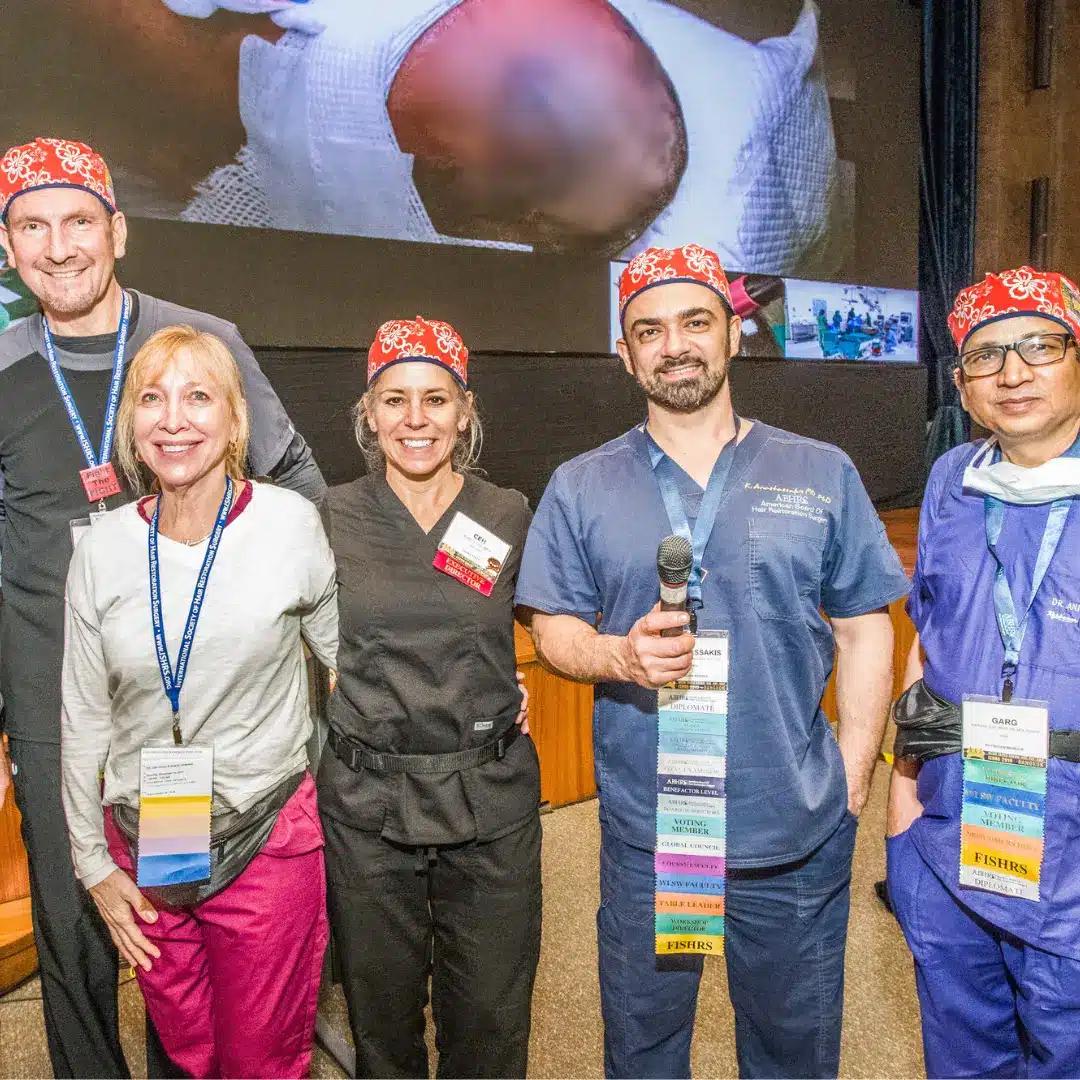


The global hair restoration community advances through hands-on training, the exchange of technical details, and real-time scientific dialogue. In this context, the ISHRS Live Surgery Workshop 2026 — held in Islamabad, Pakistan—stands out as a high-level educational event in hair transplant surgery and cutaneous and aesthetic surgery, bringing together leading surgeons from Europe, Asia, and the Americas.
Dr. Konstantinos Anastasakis, MD, PhD, FISHRS had a multidimensional presence: not only as an attendee, but as an active contributor to the scientific programme and the practical training component of modern hair transplantation techniques.
What is the ISHRS Live Hair Transplant Surgery Workshop 2026 in Islamabad?

Unlike a traditional congress, the ISHRS Live Surgery Workshop 2026 focuses on what truly builds surgical skill: the hair transplant procedure as it unfolds live, with step-by-step analysis of intraoperative decisions in real time. The Islamabad workshop (13–15 February 2026) combined scientific lectures with live demonstrations of follicular unit extraction (FUE) and follicular unit transplantation (FUT), creating an environment where critical factors—such as handling of individual hair follicles, graft angulation, and complication management—are discussed openly.
For participating physicians, the value is twofold:
- Training under real operating-theatre conditions using local anesthesia
- Exchange of experience on managing male pattern baldness, female pattern hair loss, and other causes of permanent hair loss
Dr. Anastasakis’ Presence at the ISHRS Live Surgery Workshop 2026
Dr. Anastasakis’ participation in the ISHRS Live Surgery Workshop 2026 included roles typically reserved for surgeons with recognised expertise in treating androgenetic alopecia, alopecia areata, and thinning hair: speaker, panelist, moderator, and trainer in live surgical sessions.
This multi-level involvement reflects how the international community perceives his contribution—not simply as a surgeon who performs hair replacement surgery, but as one who advances methodology in restoring scalp hair with a natural appearance and long-term planning in mind.
Key Lecture: Combining FUE & FUT to Preserve Donor Density

In his key presentation, Dr. Anastasakis addressed the topic
“Combination of FUE & FUT technique to preserve the donor density.” Why does it matter? Because in modern hair transplantation, the donor area is not “just the harvesting site.” It is a lifelong resource for the patient—especially as alopecia progresses over time. Strategic donor management determines what options exist today and, even more critically, what options will remain tomorrow if additional surgery or a corrective approach becomes necessary.
Topics analysed included:
- The biological rationale behind combining strip method (FUT) and FUE procedure
- Patient-selection criteria based on family history and medical history
- Planning according to anticipated progression of patchy hair loss or advanced bald areas
- Strategies to maximise hair grafts yield while protecting the safe donor zone
Respecting the original blood supply of transplanted grafts and avoiding follicle transection are essential in achieving optimal hair density and sustainable new hair growth.
Scientific Panels: Tips & Tricks and Full House
Dr. Anastasakis also took part in specialised panels discussing:
- Best practices in harvesting individual follicular units
- Technologies supporting minimally invasive procedures
- Techniques to minimise complications such as excessive bleeding and shock loss
- Adjunctive therapies such as platelet rich plasma (PRP) and low level laser therapy
Such discussions support predictable healing of transplanted hair and help maintain the integrity of the hair shaft and surrounding skin.
Moderating the Q&A in the ISHRS Live Surgery Workshop 2026: Techniques, Patient Selection and Expectations

Key themes included:
- Matching surgical approach to pattern of androgenic alopecia
- Determining candidacy based on good health and donor characteristics
- Establishing realistic expectations regarding hair growth over the first few months
- Integrating medical therapy into the overall hair restoration surgery plan
Hair transplantation is not a single act—it is a long-term strategy to restore hair using viable body hair or beard hair when scalp reserves are limited.
Leading Teaching Hair Surgeon at the ISHRS Live Surgery Workshop 2026

In the live surgical component, Dr. Anastasakis demonstrated:
- Surgeon harvests techniques for FUT and FUE
- Natural hairline design aligned with facial anatomy
- Creation of recipient sites for individual grafts
- Placement of transplanted grafts to support uniform density
Attention to post-operative care—including pain management and timely suture removal when required—supports healing and reduces the risk of linear scar formation.
What International Education Means for Patients
Active participation in international events translates into:
- Continuous refinement of hair replacement protocols
- Safer management of complex cases requiring corrective surgery
- Improved planning for progressive hair loss
- Long-term strategies that preserve both donor supply and aesthetic outcome
Technique selection always depends on multiple factors, including:
- Pattern of androgenetic alopecia
- Characteristics of donor hair
- Scalp condition
- Personal goals and expectations
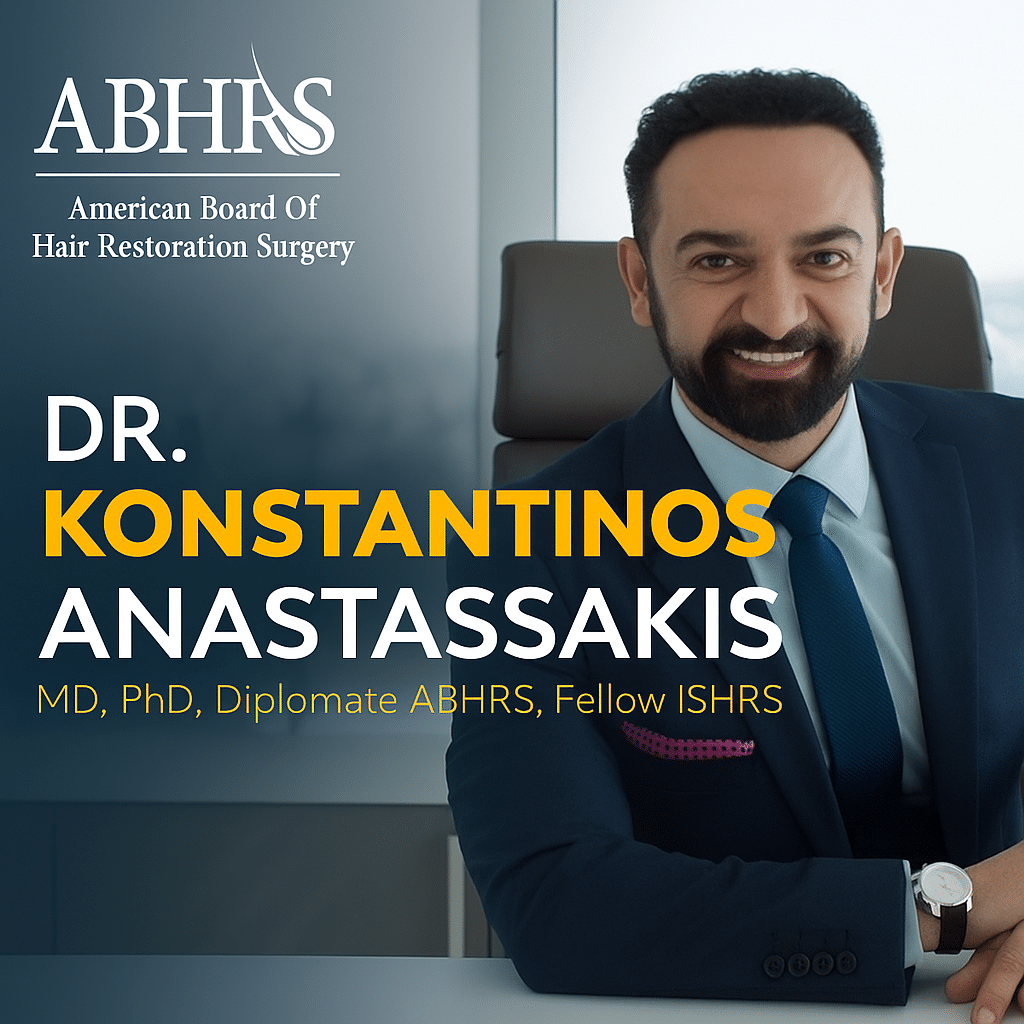
Dr. Konstantinos Anastasakis
Dr. Konstantinos Anastasakis is a certified hair transplant surgeon based in Athens, Greece, and one of only 220 Diplomates of the American Board of Hair Restoration Surgery (ABHRS) worldwide since 2015. He has served as Treasurer, Secretary, and
Vice President of the ABHRS (2017–2021) and has been an ISHRS member since 2009 and Fellow since 2019.
He maintains an active international academic presence, with more than 120 scientific presentations at conferences and publications in peer-reviewed journals such as Facial Plastic Surgery and international textbooks including Hair Loss Advances and
Treatments, part of the book series, Updates in Clinical Dermatology (Springer, 2024). He is the author of “Androgenetic Alopecia from A to Z” (Springer, 2023) and has contributed chapters in Hair Loss Advances and Treatments, part of the book series,
Updates in Clinical Dermatology (Springer 2024), including “Hair Follicle Cloning and Stem Cells” and “Hair Transplantation—From the ‘Ancient’ 4 mm Plugs to the Latest Follicular Unit Excision Technique: 8 Decades of Painful Progress”. He is also the author of “Paradigm shift from linear strip to follicular unit excision in hair restoration surgery” in Facial Plastic Surgery (2024).
FAQ
What is ISHRS Live Surgery Workshop 2026?
An educational event where live hair transplant surgery is performed and analysed in real time.
Why combine FUE and FUT?
In selected cases, combining techniques may help preserve donor site integrity and maintain long-term hair density.
What determines success?
Proper planning, correct handling of hair follicles, and alignment between technique and patient profile.
Can I find out which technique suits me?
Yes—through clinical evaluation, including scalp assessment or even scalp biopsy when indicated.
Book an assessment at Anastasakis Hair Clinic
If you are considering a hair transplant and want an individualised plan focused on natural design, high density and respect for the donor area, you can schedule your personal assessment at Anastasakis Hair Clinic.
Book your consultation and discuss all options with our team (FUE, FUT or a combination approach), what is realistic for your case, and a strategy designed to work not only today, but in the years ahead.
 0
0