


The phrase “hair transplant in Turkey” is one of the most common searches among people considering hair restoration surgery. Every day, thousands of men are exposed to aggressive advertising for “guaranteed results,” “maximum grafts,” and extremely low prices, with Istanbul often presented as the global capital of hair transplantation.
Over the past decade, Turkey has become one of the most popular destinations for hair transplant medical tourism, mainly because of low-cost packages, hotel-and-transfer deals and highly visible online marketing.
But behind the attractive prices and impressive before-and-after photos, there is a more complex reality.
The real question is not simply: “Where is it cheaper?”
The real question is: “Who will perform my surgery, under what medical standards, with what level of safety, and what kind of follow-up will I receive after I return home?”
A hair transplant is not a simple cosmetic service. It is a surgical procedure. And every surgical procedure should be evaluated based on medical expertise, safety, transparency and accountability — not price alone.
Why Do So Many Patients Travel to Turkey for a Hair Transplant?
Turkey’s popularity in hair transplantation is not accidental. Several factors have made it a powerful destination for international patients:
- very low prices compared with many European countries and the United States,
- all-inclusive packages including surgery, hotel, transfers and post-operative products,
- strong advertising on Google, YouTube and social media,
- high-volume clinics, especially in Istanbul,
- fast online sales processes through coordinators or patient consultants.
For someone researching hair transplant options, the price difference can be tempting. It is natural to ask:
“Why should I pay more in Europe when I can get a cheaper package in Turkey?”
But this is where patients need to be careful.
A hair transplant is not a product you can compare only by its final price. It is a procedure with permanent consequences for your scalp, your donor area and your appearance for the years ahead.
Myth 1: “All Hair Transplant Clinics in Turkey Are the Same”
They are not.
There are serious doctors and reputable clinics in many countries, including Turkey. The problem is not the country itself. The problem is the business model used by some clinics that promote hair transplantation as a mass-produced, standardised and “easy” cosmetic product.
The International Society of Hair Restoration Surgery — ISHRS — has repeatedly warned patients about the rise of black market hair transplant clinics, where procedures may be performed by non-physicians or inadequately trained technicians while being marketed as legitimate medical services.
So the question is not simply “Turkey or Greece?”
The real questions are:
- Who is the doctor?
- Who designs the procedure?
- Who performs the extraction?
- Who creates the recipient sites?
- Who supervises the team?
- Who is medically responsible from start to finish?
Myth 2: “If a Clinic Performs Thousands of Cases, It Must Be Better”
High volume does not automatically mean high quality.
In surgery, experience matters only when it is combined with:
- medical training,
- specialisation,
- individual planning,
- donor area management,
- strict protocols,
- quality control,
- ethical decision-making,
- long-term follow-up.
If a clinic operates like a production line, high volume can become a disadvantage. When quantity comes before quality, the patient may be treated as just another case on the schedule — not as an individual with a unique donor area, age, hair loss pattern, expectations and long-term needs.
Myth 3: “The More Grafts, the Better the Result”
This is one of the most dangerous myths in hair transplantation.
Many advertisements promise very large graft numbers in a single session. But a good result is not defined only by how many grafts are extracted or implanted.
It depends on:
- whether the grafts are healthy,
- whether they are extracted without trauma,
- whether they are placed at the correct angle and direction,
- whether the donor area is protected,
- whether the hairline design looks natural,
- whether there is a long-term plan for future hair loss.
The donor area is not unlimited. It is the patient’s most valuable resource.
If too many grafts are removed carelessly, the patient may suffer from overharvesting, meaning permanent thinning or visible damage in the donor area.
In simple terms:
It is not about taking as many grafts as possible. It is about taking the right number of grafts, from the right areas, in the right way.
Myth 4: “FUE Is a Simple Procedure, Not Real Surgery”
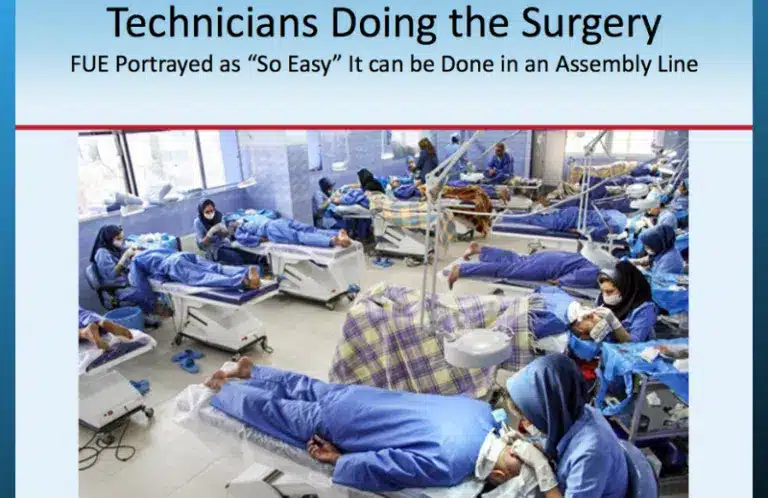
FUE is not a simple beauty treatment. It is a surgical technique.
The “E” in FUE refers to excision — the surgical removal of follicular units. This is an important distinction because it reflects the true medical nature of the procedure.
Follicular unit excision (FUE) requires amongst others:
- correct instrument selection,
- medical judgement,
- protection of the donor area.
When FUE is presented as something “easy,” “quick” or “standardised,” patients should be cautious.
The Main Risks Behind Cheap All-Inclusive Hair Transplant Packages
All-inclusive packages can seem convenient. Surgery, hotel, transfers, medication and sometimes a translator are all arranged in advance.
But the main issue is that, in some cases, the focus is placed more on the travel package than on the medical protocol.
Red flags to watch for:
- You are not clearly told the name of the surgeon who will be responsible for your procedure.
- Most communication is handled by sales representatives, coordinators or “medical consultants.”
- The main selling point is “maximum grafts for a very low price.”
- Your assessment is rushed, remote and standardised.
- It is unclear who performs the extraction, who creates the recipient sites and who implants the grafts.
- The clinic promotes the hotel and transfer package more than the doctor and the medical process.
- There is no clear follow-up plan after you return home.
When these warning signs are present, the risk is not just a disappointing cosmetic result. The risk is that a surgical procedure may be performed without the level of medical responsibility and quality control that it requires.
What Can Go Wrong After a Poor Hair Transplant?
When a hair transplant is performed with a mass-production approach or without proper medical supervision, the result may be more than simply “not ideal.”
Possible problems include:
- unnatural hairline design,
- overharvesting of the donor area,
- permanent donor thinning,
- poor growth,
- damaged grafts,
- wrong angle or direction of implanted hairs,
- visible irregularities,
- scarring,
- infection or complications if medical protocols are not properly followed,
- difficulty correcting the result in the future.
A failed hair transplant is not only an aesthetic problem. Very often, it becomes a surgical problem.
The next doctor may have to deal with damaged tissue, poor previous planning, incorrectly placed grafts and, in many cases, a donor area that has already been severely depleted.
What Happens If a Hair Transplant Abroad Goes Wrong?
At Anastasakis Hair Clinic in Athens, we often see international patients who are looking for repair hair transplant surgery after a disappointing or failed procedure abroad.
Repair surgery is always more demanding than a first-time hair transplant. The surgeon is not starting from a clean canvas. Instead, he must manage:
- an unnatural hairline,
- wrong hair direction,
- visible pluggy or poorly placed grafts,
- scarring,
- depleted donor area,
- reduced options for future coverage.
The donor area is finite. Once grafts are wasted or the donor zone is damaged, they cannot simply be replaced.
This is why the first procedure is so important.
Correcting a poor hair transplant is usually more complex, more time-consuming and ultimately more expensive than doing the first procedure correctly.
Why Travel to Anastasakis Hair Clinic in Athens, Greece for Your Hair Transplant?
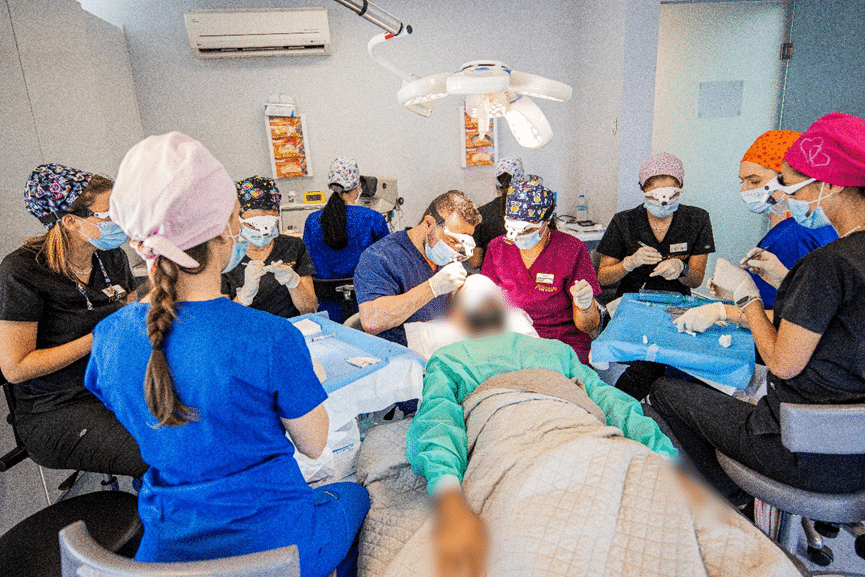
For international patients, Greece — and especially Athens — offers a very different experience from the typical mass-market medical tourism model.
At Anastasakis Hair Clinic, the goal is not to sell a quick package. The goal is to provide a medically responsible, transparent and personalised hair transplant experience in a specialised clinical environment.
1. A Doctor-Led Hair Transplant Experience
At Anastasakis Hair Clinic, your procedure is not treated as a standardised product.
Every case is evaluated individually, based on:
- your age,
- degree of hair loss,
- donor area capacity,
- hair characteristics,
- family history,
- future hair loss risk,
- expectations,
- long-term restoration plan.
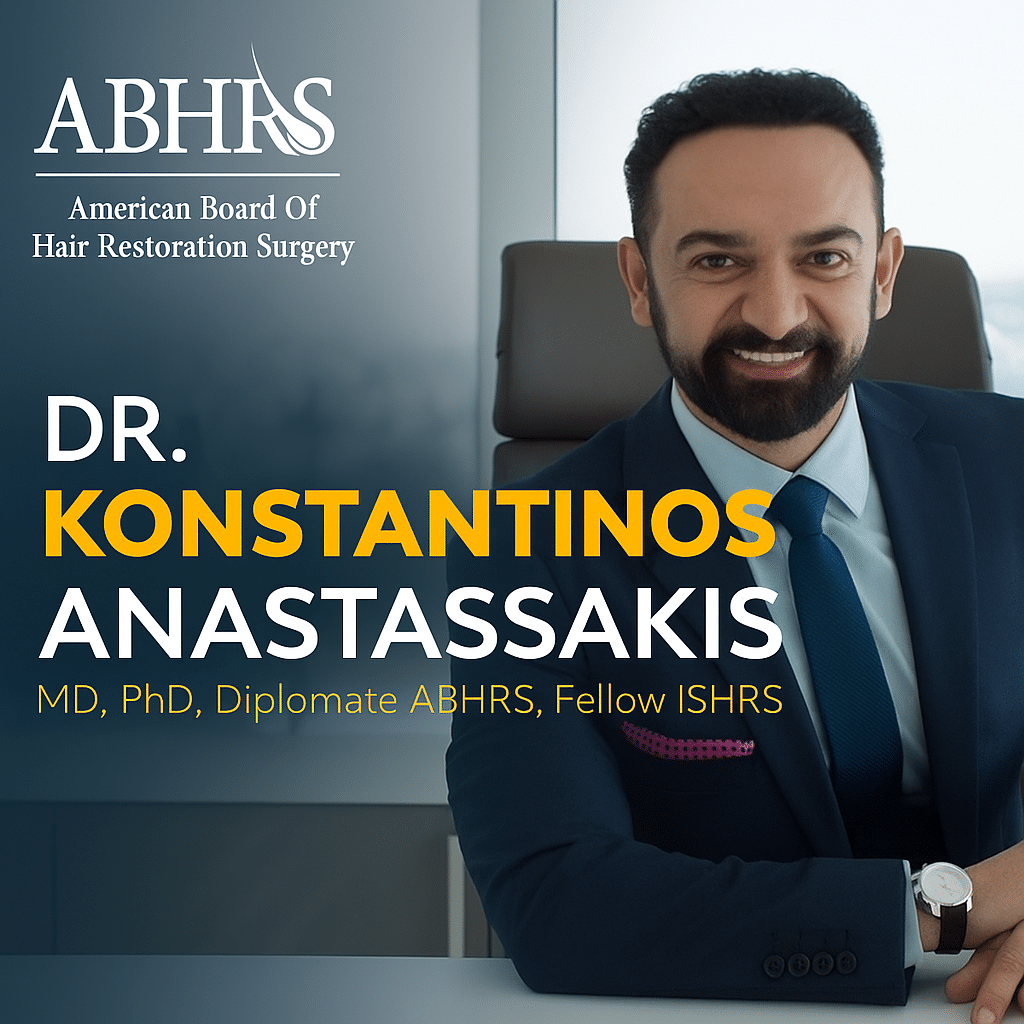
The medical plan is designed under the guidance of Dr. Konstantinos Anastassakis, MD, PhD, FISHRS, a specialised hair transplant surgeon in Athens, Diplomate of the American Board of Hair Restoration Surgery — ABHRS and Fellow Member of the International Society of Hair Restoration Surgery — ISHRS.
This matters because the most important decision in hair transplantation is not simply “how many grafts.” It is how to use the donor area wisely for a natural result that will age well.
2. Athens: A Safe, Accessible European Destination
Athens is one of Europe’s most accessible capitals, with direct international flights from many major cities.
For patients travelling from Europe, the UK, the Middle East, the United States, Australia or other regions, Athens combines:
- European medical standards,
- easy travel access,
- a familiar legal and regulatory environment,
- high-quality accommodation options,
- a safe and welcoming city experience,
- the possibility to combine medical care with a calm recovery period.
Unlike destinations where the process may feel rushed or overly commercialised, coming to Athens for a hair transplant allows patients to receive care in a more controlled, personal and medically focused environment.
3. Direct Communication and Transparency
For international patients, one of the biggest concerns is uncertainty.
- Who will I meet?
- Who will evaluate me?
- Who will perform the procedure?
- Who will answer my questions after surgery?
At Anastasakis Hair Clinic, transparency is central to the process. Patients are not expected to make a life-changing decision based only on a low-cost offer or a few edited photos.
They receive a clear explanation of:
- what is medically realistic,
- what number of grafts may be appropriate,
- what the donor area can safely provide,
- what the limitations are,
- what can be achieved in one session,
- whether more than one stage may be needed.
- This protects the patient from unrealistic promises and helps build a responsible long-term plan.
4. Real Patient Results and Video Transparency
Before choosing a clinic, patients should not rely only on marketing claims.
They should ask to see real evidence.
At Anastasakis Hair Clinic, transparency is supported by a large library of real patient results, with video documentation that allows viewers to evaluate density, naturalness and hairline design under more realistic conditions.
Photos can be useful, but videos often reveal much more: movement, angles, lighting, texture and overall naturalness.
For international patients who cannot easily visit multiple clinics before choosing, this level of visual transparency is especially important.
5. Focus on Donor Area Protection
The donor area is not an unlimited source of hair. It must be managed strategically.
A responsible hair transplant plan should not focus only on the immediate result. It should also consider:
how much donor hair can safely be used,
what may be needed in the future,
whether the patient’s hair loss is still progressing,
how to avoid visible thinning in the donor area,
how to preserve options for future procedures if needed.
At Anastasakis Hair Clinic, donor management is a central part of the treatment philosophy. The aim is not simply to extract a high number of grafts, but to protect the patient’s long-term appearance.
6. Structured Post-Operative Follow-Up
A hair transplant does not end when the procedure is completed.
The final result evolves over many months, and proper follow-up is essential. International patients need clear instructions, reliable communication and a team that remains available after they return home.
At Anastasakis Hair Clinic, patients receive detailed post-operative guidance and follow-up support. This helps them understand what is normal, what to expect during the healing and growth stages, and when to contact the medical team if they have any concerns.
Greece vs Turkey: The Difference Is Not Just Price
The difference is not simply geographical. It is philosophical.
In a mass-market medical tourism model, the patient may know the brand, the package and the price — but not necessarily the doctor responsible for the procedure.
At Anastasakis Hair Clinic, the approach is different.
The procedure is planned around the patient, not around a package. The goal is not the maximum number of grafts at the lowest possible price. The goal is a natural, medically sound and long-lasting result.
When comparing clinics, patients should not ask only:
- “How much does it cost?”
- They should ask:
- “Who is responsible for my result?”
What Should You Check Before Choosing a Hair Transplant Clinic?
Before making a decision, do not rely only on price, social media ads or before-and-after photos.
Ask clear questions:
- Who is the doctor responsible for my procedure?
- What are the doctor’s qualifications and experience?
- Is the doctor a member of recognised organisations such as ISHRS or ABHRS?
- Who designs the hairline?
- Who performs the extraction?
- Who creates the recipient sites?
- Who implants the grafts?
- How is graft quality controlled?
- How is the donor area protected?
- What follow-up is provided after I return home?
- Can I see real patient videos, not only edited photos?
- Is there a long-term plan for future hair loss?
If you cannot get clear answers to these questions, that is a warning sign.
Frequently Asked Questions About Hair Transplants in Turkey and Abroad
Is hair transplant surgery in Turkey safe?
It can be safe if performed by a qualified, experienced and properly certified doctor in a legitimate medical facility with clear protocols and proper follow-up.
The problem is not Turkey itself. The problem is choosing a clinic where the procedure is performed in a high-volume, low-transparency model and the patient does not know who is actually responsible for the surgery.
Why are hair transplants in Turkey so cheap?
Lower prices may be related to lower operating costs, strong medical tourism infrastructure, intense competition and high-volume business models.
In some cases, however, low prices may also reflect reduced physician involvement, delegation of critical surgical steps to technicians and a large number of procedures performed in one day.
Is it wrong to travel abroad for a hair transplant?
No. Travelling abroad for a hair transplant can be a good decision when the clinic is transparent, medically responsible and doctor-led.
The issue is not travelling. The issue is choosing based only on price, convenience or a package without understanding who will perform the surgery and what kind of follow-up you will receive.
How do I know if a clinic is a “hair mill”?
Possible warning signs include:
- the doctor’s name is not clearly presented,
- most communication is handled by salespeople,
- you are promised very high graft numbers without detailed assessment,
- you are pressured to book quickly,
- it is unclear who performs each stage of the procedure,
- there is no meaningful follow-up plan,
- the package is promoted more than the medical process.
Are before-and-after photos enough?
No. Photos are useful, but they can be misleading if lighting, angles, hair length or styling are not consistent.
Look for:
- similar lighting,
- similar angles,
- clear hairline views,
- wet or comb-through results where possible,
- video documentation,
- realistic density assessment.
Always keep in mind that ONLY Video results can give an honest impression of naturalness and density than static images alone.
Can a failed hair transplant be repaired?
Not always easily.
Repair depends on the condition of the donor area, the previous design, the number and quality of grafts already used, the amount of scarring and the patient’s remaining donor capacity.
A repair procedure is often more difficult than a first hair transplant. This is why choosing correctly the first time is so important.
Why should I choose Anastasakis Hair Clinic in Athens?
You should consider Anastasakis Hair Clinic if you are looking for a doctor-led, transparent and medically responsible hair transplant in Europe.
The clinic offers:
- specialised hair transplant surgery in Athens, Greece,
- an internationally recognised hair restoration surgeon,
- focus on natural results and donor area protection,
- extensive real patient video documentation,
- clear communication before surgery,
- structured follow-up after the procedure,
- care within a European medical environment.
Final Thought: Do Not Choose a Hair Transplant Based on Price Alone
Cost is an important factor. But a hair transplant is a surgical procedure with permanent consequences.
Your donor area is limited. Every graft is valuable. And your first procedure is the most important one.
Before choosing a clinic, compare more than prices. Compare:
- who will perform your surgery,
- who takes responsibility for your result,
- how your donor area will be protected,
- what evidence of results exists,
- what follow-up you will receive,
- whether the plan is realistic for your long-term hair loss.
A hair transplant should not be treated as a travel deal. It should be treated as a medical decision.
Research carefully. Compare responsibly. Choose a qualified doctor who is willing to be fully accountable for your result.
If you are considering a hair transplant in Europe and want a responsible, science-based evaluation, you can book an online or in-person consultation with Anastasakis Hair Clinic in Athens, Greece.
Discover what you truly need — before you make your decision.
 0
0