

Temple Hair Transplants: Restoring Balance and Youthful Vitality Temple hair transplantation and restoration is among the most common hair transplant procedures, as it is considered the most effective solution for those experiencing thinning in this area.
Hair transplantation in the temples greatly impacts facial appearance since the temples define the balance and symmetry of the facial frame. A successful temple hair transplant can restore harmony while accentuating features like the eyes and forehead, resulting in a more youthful and natural look.
Thinning in the temples often gives the impression of an enlarged forehead, which is associated with aging and loss of youthful appearance. Moreover, the temples play a crucial role in the overall aesthetics of the hairline, influencing the overall look of your hair.
In this article, drawing from our scientific expertise and experience in hair transplantation, we will examine the issue of temple thinning. How does it affect an individual’s confidence? What challenges can a temple transplant present? And how important is it to maintain healthy hair in this area? These are common questions among many prospective patients, and it’s time to provide clear answers!
Temple Hair Transplant: Addressing Thinning in This Specific Area
Hair loss in the temples can affect not only one’s appearance but also their confidence. People facing this issue often seek solutions that will help them restore both their hairline and self-esteem.
The temples are the areas located on the sides of the head. Together with the hairline, the temples are among the first regions affected by androgenetic alopecia, showing thinning even at a young age.

The phenotypic presentation of androgenetic alopecia is characterized by gradual thinning and hair loss, starting from the frontal areas and temples. Subsequently, the crown and vertex regions become involved. Over time, these areas may merge into a completely bald surface in about 7-10% of men, reaching stage VII according to the Norwood-Hamilton scale.
We observe the hairline receding, while the temples gradually widen and extend backward.
As a result, men exhibiting this type of thinning often appear older than their actual age. This happens simply because, typically, the younger a man is, the tighter the temples and the lower the hairline. Thanks to modern advances in medicine and cosmetology, these issues can now be easily addressed with a temple hair transplant. But before delving deeper into this procedure, let’s first explore why the temples thin out.
When Is a Temple Hair Transplant Necessary?
A hair transplant in the temples becomes necessary when there is noticeable thinning or hair loss that affects the symmetry and aesthetics of the face. Common cases requiring transplantation include hereditary hair loss (androgenetic alopecia), where the temples are among the first areas affected, causing a characteristic recession of the hairline.
Other situations include aesthetic needs to improve the hairline, as well as conditions related to traction alopecia, where hair thinning occurs in the temples due to excessive pulling (e.g., from tight hairstyles). In all these cases, transplantation offers an effective solution, restoring density and aesthetic balance.
Why Do the Temples Thin Out?
This condition is primarily caused by the influence of androgens, such as testosterone, and more specifically dihydrotestosterone (DHT), a derivative of testosterone. The hairline and temples are often the first areas affected by androgenetic alopecia for the following reasons:
- Sensitivity to DHT: Hair follicles in the hairline and temples are more sensitive to the effects of DHT. This sensitivity is largely genetically determined. DHT binds to receptors in these sensitive follicles, causing them to shrink, resulting in thinner, weaker hair that eventually falls out.
- Genetic Predisposition: Heredity plays a significant role in how sensitive the follicles are to DHT. If there is a family history of androgenetic alopecia, the likelihood of experiencing hair loss increases.
- Hormonal Changes: The production and conversion of testosterone to DHT are influenced by hormonal changes, which can vary between individuals. This also explains why some people show signs of androgenetic alopecia at a younger age than others.
Why Choose Temple Hair Transplantation to Combat Thinning?

A temple hair transplant is arguably the most effective solution for addressing hair thinning in this specific area. Reconstructing the hairline and filling in the temples is a highly specialized procedure that requires advanced expertise to achieve a result that is both dense and completely natural.
This is a technically demanding process that targets localized hair loss. While it follows the general principles of hair transplantation, temple restoration focuses on implanting hair follicles in a way that redesigns the hairline and restores the temples. The goal is to lower and refine the temple area—within the limits of the patient’s age and facial features—ensuring a natural-looking outcome.
There are clear guidelines regarding the height, shape, depth, angle of implantation, type of grafts used, and the irregular design of the hairline and temples—all of which contribute to a truly natural appearance.
The design of the temple transition zone is crucial, as it shapes how the front hairline blends into the temple areas, creating a harmonious and balanced look. Precise replication of hair characteristics in this zone is essential to ensure the transplanted hair matches seamlessly with the existing hair. The surgeon must carefully consider the natural angles and growth directions to deliver a result that is both aesthetically pleasing and symmetrical.
Keep reading to discover the key benefits of temple hair transplantation.
The Benefits of Temple Hair Transplantation
Choosing temple hair transplantation can bring about a noticeable transformation—not only in your hair but in your overall confidence and mood. Some of the key benefits include:
- Improved Appearance: Reconstructing the temple area can redefine your hairline, offering a more youthful and natural look.
- Boosted Confidence: A better appearance often leads to enhanced self-esteem and confidence in both personal and professional settings.
- Restored Density: Hair transplantation restores density in the temple region and along the hairline, resulting in a fuller, more vibrant head of hair.
Permanent Results: Just like in other areas, a temple hair transplant delivers permanent results. The transplanted hair is resistant to hormones like DHT, meaning it will remain in place for a lifetime.
The Challenges of Temple Hair Transplantation
The greatest challenge in temple hair transplantation—when restoring hair growth in this area—is replicating nature with the highest possible precision. The transplanted hair must seamlessly match the existing hair in terms of direction, angle, and texture.
The goal is for this highly visible area—the first one people notice when looking at someone—to look completely natural, without any sign that a hair transplant has taken place. Equally important is achieving high graft density in this region, closely mimicking how natural hair would appear if no hair loss had occurred.
Watch the video to see examples of failed temple hair transplants, where poor outcomes resulted from low-density implantation and/or incorrect design—such as linear graft placement or unnaturally angular, triangular hairlines.
Options for Temple Hair Transplantation
When it comes to temple hair transplantation, there are no real “options.” The result will either be dense and indistinguishable from natural hair—or it will look unnatural, even due to the slightest error. The temple area and the hairline offer zero margin for error when it comes to replicating nature.
Any minor mistake—whether in shape, angle, direction, or density—will stand out and immediately reveal that the person has undergone a hair transplant. It’s important to remember: a successful hair transplant is one that doesn’t betray itself. The goal is for no one to be able to tell that anything has been done.
Tips for Maintaining Healthy Hair in the Temple Area
Thanks to advancements in medicine and technology, there are now alternatives to temple hair transplantation. Hair loss in this area can also be successfully managed through approved treatments—especially when diagnosed early and guided by a specialist who recommends the best therapy based on the specific type and stage of thinning.
There are three medically approved treatments for androgenetic alopecia:
- Minoxidil and Finasteride: These two pharmaceutical solutions have been extensively studied in thousands of patients worldwide. They are proven to not only slow down hair loss but also stimulate new growth—provided that the hair follicles remain healthy.
- Low-Level Laser Therapy (LLLT): This non-invasive, non-pharmaceutical treatment uses low-level lasers to stimulate cellular metabolism, encourage the natural production of growth factors, and enhance scalp microcirculation. As a result, it gradually improves hair health, making it thicker and stronger over time. LLLT is officially recognized as a safe and effective method for promoting hair follicle activity.
What Are the Results of a Temple Hair Transplant?


See How Natural the Results of a Temple Hair Transplant Can Be
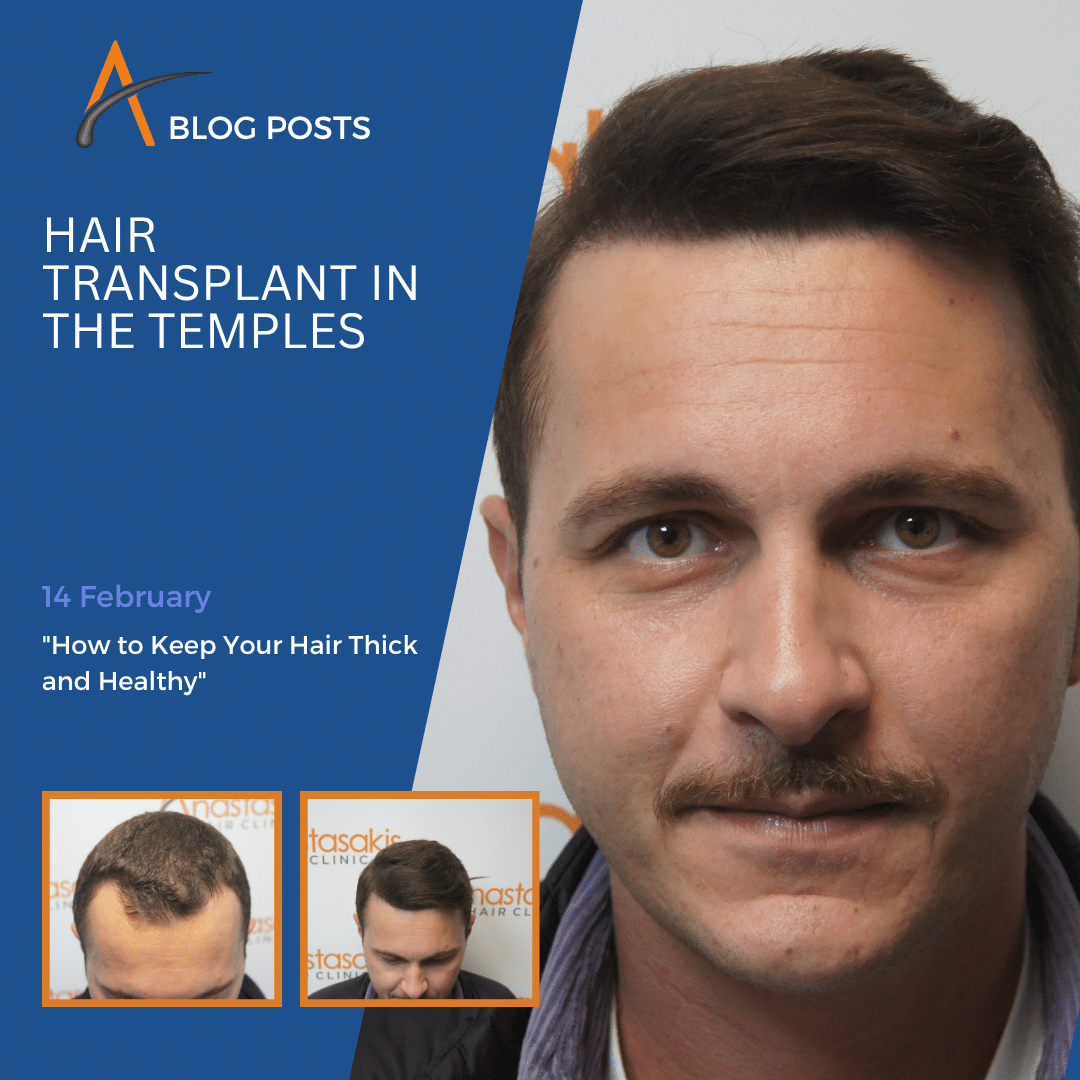
The results of a temple hair transplant can be truly impressive—especially when the procedure is performed using advanced techniques by experienced surgeons. When executed properly, the transplanted hair in the temple area looks completely natural, with the angle and direction of growth carefully mimicking the natural hair pattern for a seamless aesthetic outcome.
Following the procedure, patients often notice a significant improvement not only in their appearance but also in their confidence and overall mood. Before-and-after photos clearly reveal the restored density and natural look of the hairline, which blends harmoniously with the rest of the facial features.

Watch Vasilis’ video 1 year after his hair transplant on the temples

Watch Antonis’ video 8 months after his temple transplant.
You can also see all the cases from Anastasakis Hair Clinic where hairline reconstruction and temple filling were performed.
Is a Temple Hair Transplant the Right Option for You?
A temple hair transplant is an ideal solution for individuals experiencing thinning or hair loss in this specific area. Deciding to undergo this procedure depends on several key factors, including age, the extent of hair loss, the overall condition of the donor area, and the patient’s desire to restore a natural-looking hairline.
It is crucial to determine whether hair loss has stabilized or is still progressing, as undergoing surgery too early may lead to the need for future corrections. A consultation with a specialized and experienced hair transplant surgeon is essential for properly evaluating your condition and guiding you toward the most effective restoration strategy.
The Importance of Choosing the Right Doctor for a Temple Hair Transplant
The key to maintaining healthy hair in the temple area—and potentially delaying or even avoiding a transplant—is early diagnosis by a specialized hair restoration doctor. If your temples have already receded significantly and you feel the time is right to proceed with a temple hair transplant, it’s crucial to trust a doctor who will develop a comprehensive restoration strategy tailored to your needs.
Choose a doctor who will design a hairline that complements your age and facial features. Opt for a surgeon who can show you numerous case studies of patients with temple thinning similar to yours, in terms of age, hair texture, and hair loss pattern. Always ask to see videos showing before-and-after results.
These real-life examples allow you to accurately evaluate the skill and artistry of the surgeon you plan to trust. A reputable clinic should be able to present a wide range of video results, demonstrating a consistent history of successful hair transplant procedures.
If you are considering a temple hair transplant—or any type of hair restoration—browse through the hundreds of patient result videos from those who trusted us, and book your free consultation with Anastasakis Hair Clinic. Together, we’ll design the best strategy to restore density and balance to your temple area.
 0
0