

With the advancement of science and technology, various popular treatments have been developed to combat hair thinning, including mesotherapy for hair. In recent years, some hair transplant clinics—and even more aesthetic institutes offering hair treatments—have been promoting its unique benefits! It is often advertised as an innovative and non-invasive method that helps hair growth, reduces or stops hair loss, and overall improves hair quality by increasing its density. But is mesotherapy for hair truly as effective a treatment as most of those who advertise it claim?

What is Hair Mesotherapy?
Mesotherapy (from the Greek words “mesos” meaning middle and “therapy”) is a form of alternative medicine that involves intradermal or subdermal injections of pharmaceutical substances, enzymes, hormones, plant extracts, vitamins, and/or other components. Its clinical effectiveness for most applications has not been proven and it lacks sufficient scientific support from clinical studies.
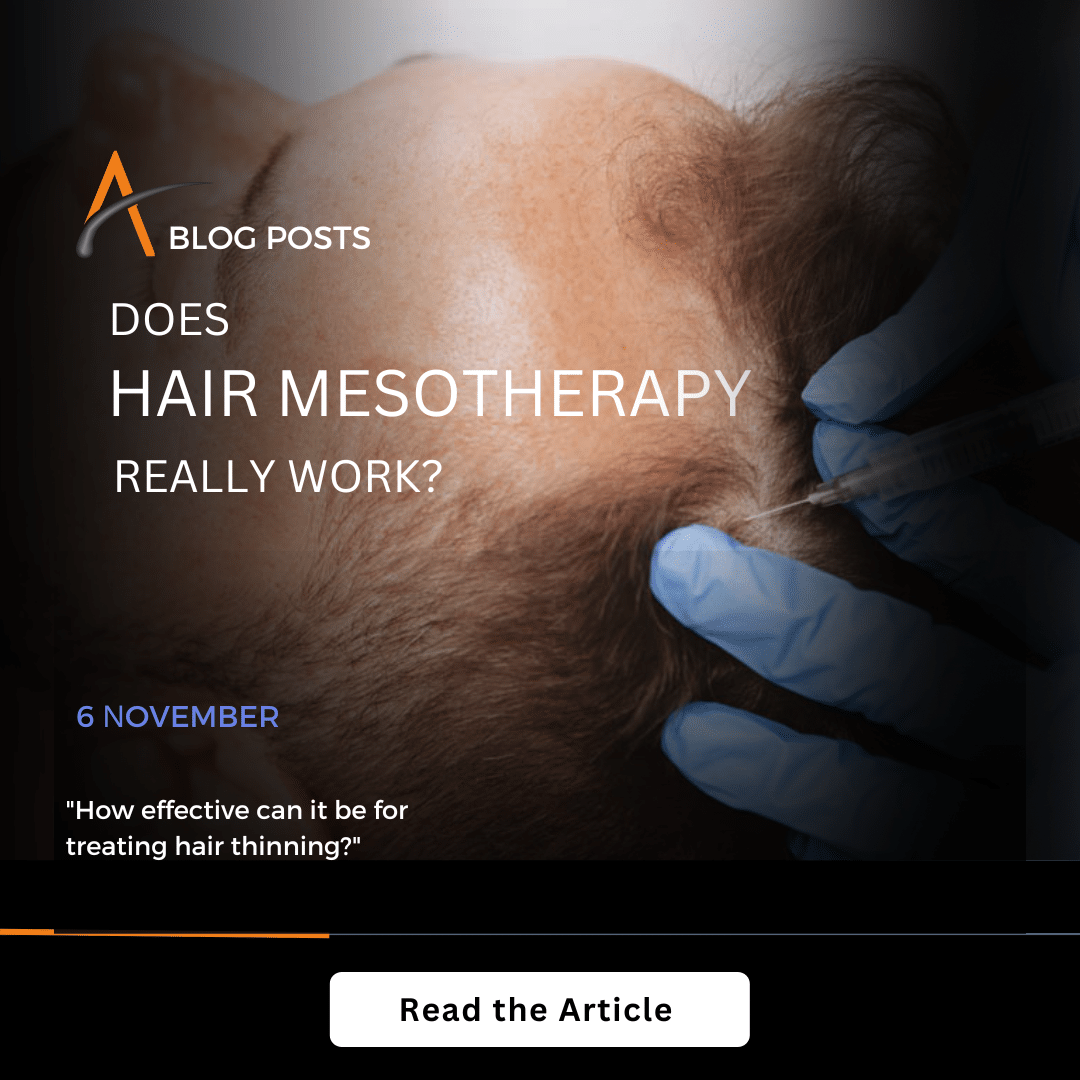
Hair mesotherapy is a non-invasive method aimed at improving the health and quality of hair. During this treatment, a series of small injections are applied to the scalp skin, containing nutrients, vitamins, and antioxidants. These injections target promoting hair growth, improving hair structure, and combating hair loss.
Mesotherapy in aesthetic dermatology has been used for many years and is a particularly popular method for preventing and treating various skin problems. The main reason for its popularity is that it is a mild invasive, non-surgical technique used for skin renewal, hydration, and tightening. It is mainly applied to treat fine wrinkles and lines, anti-aging, and acne scars.
How effective is it?
At first glance, what you see online is that hair mesotherapy — whether heterologous or autologous — is advertised as a highly promising treatment against hair loss and effective for various types of alopecia that can transform your hair. This is strongly promoted by many institutes offering facial and body mesotherapy, so under this umbrella, hair mesotherapy is presented as an innovative and equally miraculous treatment for hair.
While many “hair experts” claim that mesotherapy has a success rate ranging from 90% to 92% in hair regeneration, scientific studies conducted so far on hair mesotherapy have not shown the expected results. Additionally, there is a lack of large-scale studies regarding its effectiveness as well as its safety profile.
In fact, with a more serious and thorough search on websites of doctors specializing in hair transplantation and hair loss treatments, you will see that many mention mesotherapy may have positive effects on hair renewal, but its effectiveness can vary depending on the patient’s case. Even a specialized doctor cannot guarantee that the procedure will have the expected results or that your money won’t be wasted — especially since this is not an inexpensive treatment.
Is there a difference between Hair Mesotherapy and PRP Mesotherapy?
Hair mesotherapy is divided into two main categories:
- Heterologous Hair Mesotherapy:
In this method, mixtures of nutrients and nourishing substances such as vitamins, amino acids, and antioxidants are directly injected into the scalp using microneedles. The goal is to boost hair growth and improve hair health. - Autologous Hair Mesotherapy:
In this process, the substances injected into the scalp come from the patient’s own body, which is why it is considered a safe treatment without side effects, as it uses the patient’s own biological elements. In autologous hair mesotherapy, there are two types:

Hair Mesotherapy with Plasma (PRP):
In PRP mesotherapy, plasma from the patient’s own blood, rich in growth factors and platelets, is used. This plasma is injected into the scalp with microneedles and theoretically promotes hair growth, reduces hair loss, and improves hair quality.
Hair Mesotherapy with Stem Cells:
In this method, stem cells from the patient are used, which are also injected into the affected area of the scalp. Stem cell mesotherapy promises complete reconstruction and regeneration of the tissue in the area.
What Hair Mesotherapy IS NOT
It is not the topical application of substances containing vitamins, antioxidants, essential oils, etc., using a device or a simple syringe on the scalp. Some unscrupulous people present a device or syringe that instead of a needle has a cotton piece at the tip, which they soak with the substances and then rub on the scalp. Sometimes there isn’t even cotton — they just drop a small amount of the “miraculous cocktail of active ingredients” with a syringe and massage it into the scalp. They call this “non-injection mesotherapy,” which is obviously a scam if someone calls it mesotherapy.
Also, any cream or lotion applied at home with the help of a “special” device and marketed as “home mesotherapy” or “herbal mesotherapy,” etc., which clearly does not involve intradermal or subdermal injections, is not mesotherapy.
Hair Mesotherapy & Hair Transplantation
While, as mentioned earlier, there are not many reliable published studies supporting the effectiveness of hair mesotherapy against hair loss, there are numerous published studies highlighting the benefits of autologous PRP mesotherapy in hair transplantation. In this case, PRP helps improve graft survival, accelerates and optimizes healing in both the donor and recipient areas. However, essential prerequisites to ensure the success of this procedure are:
a) an adequate amount of PRP sample from the patient, and
b) technological equipment that guarantees the quality of the sample without damaging it, so that the application is performed correctly.
Hair mesotherapy may be a promising option in the future for those facing hair thinning issues, but for now, things are not exactly as advertised by promotions claiming it to be a revolutionary and highly effective treatment, primarily aimed at financially exploiting patients. That is why it is important to be careful about whom you trust. Seek out a clinic or a doctor specialized exclusively in hair transplantation who can guide you to the best solution for your problem.
If you want to learn more about the effectiveness and types of hair mesotherapy, and whether it is appropriate for your hair thinning, book an informational appointment today. We will be happy to schedule an in-person consultation to determine the best and most effective treatment for your hair thinning and whether a hair transplant is the solution that will transform your hair permanently.
με τη μεταμόσχευση μαλλιών και που θα σας κατευθύνει στην καλύτερη λύση για το πρόβλημα που αντιμετωπίζετε.
Comparison Between Hair Mesotherapy and Hair Transplantation
Hair mesotherapy is a non-invasive treatment for hair loss and thinning, but its effectiveness remains questionable.
Hair transplantation, on the other hand, is a surgical procedure that covers and thickens thinning areas of the scalp, with a 100% success rate—provided it is performed by a specialized and experienced hair transplant surgeon.
Additionally, while autologous hair mesotherapy may show better results in certain types of hair loss, its effectiveness in treating androgenetic alopecia remains uncertain.

Finally, it is important to note that, according to the U.S. FDA, the only officially approved treatments for hair loss—aside from hair transplantation—are minoxidil, finasteride, and low-level laser therapy (LLLT).
Hair mesotherapy is not yet recognized as an effective treatment for hair loss.
 0
0