

Hair Transplantation in Women: A Complex Solution to Hair Loss
For some women, hair transplantation may seem like the answer to the distressing issue of hair loss. However, in most cases, women are not ideal candidates for the procedure.
While hair loss can be an emotionally charged experience for men, for women, it is often psychologically devastating. In men, androgenetic alopecia is generally perceived as an undesirable but natural and expected condition. In contrast, the experience of hair loss in women—even in older age—is profoundly different. Female Pattern Hair Loss (FPHL) can cause intense emotional distress, severely impacting a woman’s self-image, femininity, sexuality, and her perceived role within both society and the family.
Why Are Most Women Not Ideal Candidates for Hair Transplantation?
“In hair transplantation, we extract hair follicles from the donor area—typically the back of the scalp—and implant them into areas affected by thinning or baldness.
However, in most women, hair loss tends to occur diffusely and uniformly across the entire scalp. This means that as hair thins on the top of the head, the donor area also experiences similar thinning. As a result, it becomes impossible to harvest hair from an already thinned area and transplant it into another area that is equally sparse.”
Why Hair Transplantation in Women Was Technically Challenging in the Past
Historically, performing hair transplantation in women presented significant technical difficulties. On one hand, the anatomically smaller donor area in the female scalp often couldn’t provide a sufficient number of grafts to adequately cover the thinning recipient area. On the other hand, in cases of female pattern hair loss (FPHL), the recipient area almost always retains some level of hair growth—even if sparse.
As a result, older techniques such as creating recipient sites with 4mm punches, as well as procedures like scalp reductions, lifts, and flaps, often led to the removal of valuable hair follicles from the recipient area itself, making cosmetic improvement nearly impossible.
However, modern hair transplant techniques have eliminated these disadvantages. Today, hair transplantation in women is one of the fastest-growing areas in the field over the past 15 years. An increasing number of women are now consulting with hair transplant surgeons to explore the possibilities that the latest techniques can offer.
Hair Transplantation in Women vs. Men
Key Differences That Surgeons Must Consider
There are several important factors that significantly differ between female and male hair transplant candidates. These parameters must be carefully evaluated by the surgeon when determining whether a woman is a suitable candidate for the procedure and when planning the surgical approach.
Anatomical Differences Between Men and Women
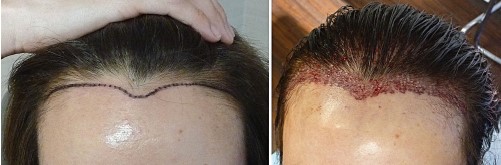
- Hairline DesignHairline design in women offers greater variability compared to men. Although the hairline is often preserved in women affected by Female Pattern Hair Loss (FPHL), temple recession is observed in approximately 87% of cases. At Anastasakis Hair Clinic, we understand the unique design characteristics of the female hairline, and we carefully reconstruct it to restore proper facial framing and femininity.
- Hairline PreservationAlmost all men undergoing hair transplantation require full hairline reconstruction. In contrast, most women retain their natural hairline and primarily seek density restoration in the midscalp region. Another key difference is that the natural female hairline does not typically change over time—it remains stable with age. Therefore, if reconstruction is needed, it should not appear “recessed,” but instead be designed to reflect that long-term stability, as this is consistent with the natural aging pattern in women.An important insight regarding the female hairline is this: a woman with minor recession may be anatomically “normal”—but the female patient does not merely seek to appear normal; she wants to look beautiful. For this reason, there is absolutely no contraindication for a surgeon to design a strong, well-defined hairline that will suit her for life, regardless of age.
Lastly, macro-asymmetries and whorls are more common in the female hairline and must be taken into careful consideration during the design process.
- Recipient Area Density in Women
In women with Female Pattern Hair Loss (FPHL), the recipient area almost always retains some degree of existing hair growth, even if sparse. Therefore, creating recipient sites requires extreme precision to avoid damaging the remaining healthy hair follicles. Patients should also be clearly informed that hair thinning in the recipient area may continue to progress gradually over the years—even after undergoing a hair transplant—and that additional sessions may be required in the future to maintain or improve density in areas such as the midscalp.
- Donor Area Density in Women The female donor area differs from the male donor area in three important ways regarding follicular density:
- It is naturally less dense than the male donor zone.
- Miniaturization of hair follicles is often present, even in the occipital (back of the scalp) area.
- The total number of follicular units (FUs) available is significantly lower.
As a result, the overall quality of donor grafts in women ranges from moderate to poor when compared to the average male donor grafts. The total hair yield (calculated as follicular density × graft density) is also substantially lower.
Additionally, the transplanted follicles from the donor zone may continue to miniaturize over time—if that was their natural progression in their original location. This phenomenon is not typically seen in men with androgenetic alopecia, where the donor follicles are usually genetically stable.
- Smaller Donor Area The female skull is generally smaller in volume and circumference than the male skull. Moreover, the “safe” donor zone in women does not extend as far toward the tragus (near the ear), due to the risk of future thinning in the temporo-mastoid region. This can potentially expose the linear scar in procedures like strip harvesting.
- Body Hair FUE in Women Women have a much lower number of terminal hair follicles on the rest of the body that can be used for scalp transplantation. With the exception of follicles in the axillary (underarm) and pubic regions, body hair follicles in women are usually of small diameter and limited aesthetic value
Technical Differences Between Female and Male Hair Transplantation
- Recipient Area Unlike men, women typically do not consent to shaving the recipient area—the region where the grafts are implanted. This restriction makes it more challenging for the surgeon to clearly visualize the scalp and accurately place grafts at the correct angle and direction. As a result, performing large-scale sessions (megasessions) in female patients is practically unfeasible.
- Better Postoperative Coverage Due to generally longer hair, women are able to conceal the recipient area more effectively during the healing process. This allows for greater discretion in the early postoperative period and reduces social downtime.
- Slower Visible Results Hair regrowth in the recipient area tends to occur more slowly in women. Since women typically wear their hair longer than men, the final visible outcome of the transplant is achieved only once the new hairs reach the same length as the existing ones—usually around 12 to 15 months after the procedure.
- Donor Area Women are also less likely to accept shaving of the donor area, which can complicate follicle harvesting during surgery. Without shaving, it is more difficult for the surgeon to precisely identify follicular units and their natural growth angles. For this reason, FUE procedures in women are often performed using combo-FUE or camouflage-to-go techniques, which allow for partial shaving or minimal visible disruption while still providing effective graft extraction.
Which Women Are Ideal Candidates for Hair Transplantation?
There are certain women who are more fortunate when it comes to hair restoration—they possess a healthy and dense donor area. These women are considered ideal candidates for hair transplantation and can achieve truly outstanding results.
But when exactly is a woman deemed suitable for a hair transplant?
At Anastasakis Hair Clinic, we carefully evaluate each patient through a thorough medical consultation, clinical assessment, and scalp analysis. Women who are ideal candidates typically present with:
- Stable donor area with no signs of diffuse thinning or miniaturization
- Localized hair loss, such as traction alopecia, scarring alopecia, or high hairline
- Female Pattern Hair Loss (FPHL) limited to specific zones (e.g., temples or midscalp)
- Good overall scalp health and no active dermatological conditions
Once candidacy is confirmed, the most suitable technique is selected based on the patient’s needs, donor characteristics, and aesthetic goals. In many cases, advanced FUE techniques—such as long-hair FUE, no-shave FUE, or combo-FUE—are used to ensure minimal downtime and optimal aesthetic outcomes.
Women with Female Pattern Hair Loss (FPHL)
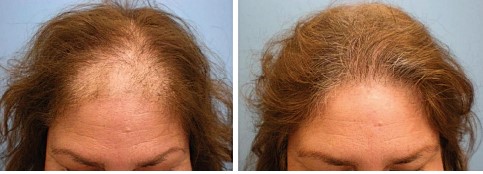
In women presenting with typical FPHL at the Ludwig stage, hair transplantation is indicated primarily for increasing density in the midscalp area.
For women exhibiting FPHL according to the Norwood-Hamilton classification, the indication usually involves reconstruction of the hairline and the frontotemporal angles (see Fig. 2).
Women with High Hairline
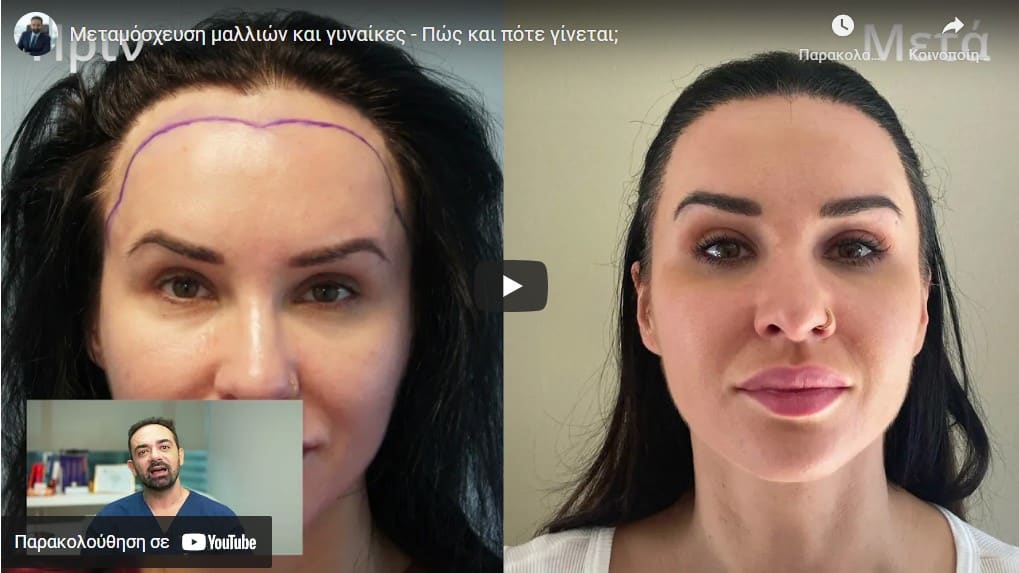
The ideal female hairline is typically located 5–6 cm above the glabella and begins at the point where the forehead transitions from a vertical to a horizontal orientation.
A high hairline may be hereditary, a consequence of female pattern hair loss (FPHL), or the result of a previous cosmetic procedure.
An alternative treatment for a high hairline is the hairline advancement technique. However, this surgical approach carries a common risk of forehead numbness (hypoesthesia).
Women with a Wide Forehead and Hairline
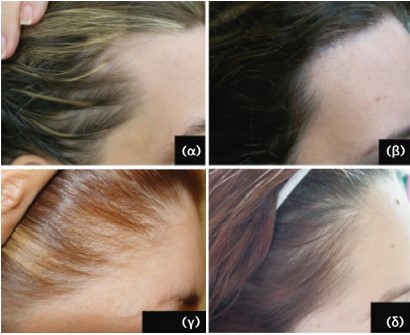
Forehead reduction surgeries can only correct the height of the forehead but do not alter its width or the shape of the frontotemporal angles.
With hair transplantation, however, the hairline can be fully redesigned, and the frontotemporal angles can be reshaped to appear either straight or curved (see Fig. 3).
Scars from Previous Cosmetic Procedures
Many modern cosmetic procedures in women can result in complications such as distortion of the hairline and temporal areas, visible scarring, and sometimes permanent alopecia.
These scars can be effectively concealed through hair transplantation.
Cicatricial and Traumatic Alopecia
A small percentage of women develop cicatricial (scarring) alopecia. When the scarring alopecia is stable, hair transplantation is an absolute indication and may be combined with excision of the scarred area. Hair transplantation is also absolutely indicated in cases of traumatic and post-burn alopecia.
The advanced hair transplantation techniques we employ at Anastasakis Hair Clinic enable a large proportion of women to benefit from these procedures. The demands of female hair transplantation differ and are generally higher than those of male hair transplantation. Regardless of whether the surgeon applies strict or lenient selection criteria, the technical and anatomical complexities of female hair transplantation will truly challenge their expertise.
Proper planning, honest and thorough patient education, adherence to indications, and meticulous surgical technique can yield excellent results for women with alopecia, significantly improving their quality of life.
Which Hair Transplant Technique is Best Suited for Women?
According to Dr. Anastasakis:
“At Anastasakis Hair Clinic, we apply all available hair transplant techniques. This gives us the advantage of selecting the most suitable method tailored to each individual woman.
However, as mentioned earlier, 8 out of 10 women interested in hair transplantation are not ideal candidates. Nonetheless, our clinic offers alternative solutions to help manage hair thinning and female hair loss without the need for transplantation.”
If you are a woman experiencing hair thinning, the best step is to book a free online consultation to learn about hair transplant costs and how we can help you develop a personalized strategy to combat your hair loss.
If you turn out to be a suitable candidate for hair transplantation, we can certainly provide you with a fully satisfying result — without the need for shaving, haircuts, or any visible signs of surgery. The only thing you will notice is a completely natural and refreshed appearance.
Visit our hair transplant results page to see real cases of our patients and be convinced by their transformations!
 0
0