

Recipient Area: Key Concepts
The recipient area is the most important part for the patient, whose main priority is to achieve a dense and natural result. Ensuring the highest possible graft survival and the most natural appearance depends on multiple factors, which will be analyzed collectively and sometimes individually in the following sections.
These factors include:
-
Area to be covered and the extent of the recipient zone
-
Number of available grafts
-
Quality of the grafts
-
Quality of the recipient scalp
-
Target density
-
Patient’s age and the expected progression of hair loss
-
Surgical skill and aesthetic perception of the surgeon
-
Patient’s desires and expectations
During a hair transplant, follicular units (FUs) are essentially transferred from the donor area to another region of the scalp, which is always hormone-sensitive, except in cases where the transplant addresses conditions other than hair loss.
For purposes of systematization and surgical planning, the entire hormone-sensitive scalp area is divided into four main surgical zones.
Definition of the Four Main Surgical Zones in Hair Transplantation
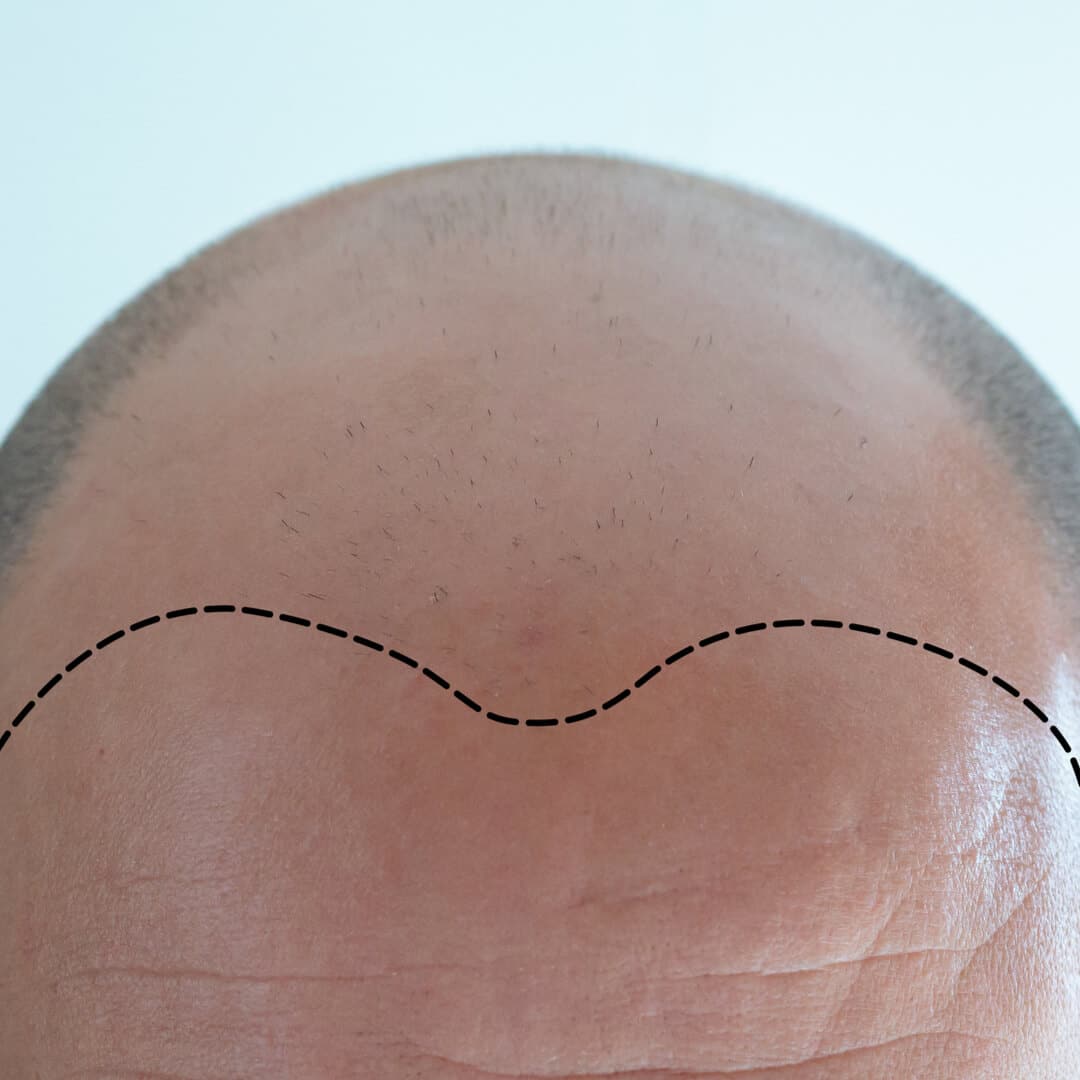
Anterior Zone
The anterior zone extends from the hairline (front) to an imaginary line (back) that runs across the scalp from one ear tragus to the other. This imaginary line is curved forward, so that if the entire anterior zone undergoes hair follicle transplantation and the areas behind it are thin or bald, the side view appears more natural compared to a straight posterior boundary.
The lateral boundaries of this zone are the frontotemporal angles and the anterior part of the temporoparietal region.
Midscalp
The midscalp is the main horizontal surface of the scalp, located directly behind the anterior zone. The lateral boundaries are the temporoparietal hairlines, while the posterior boundary is the vertex transition point, which marks the point along the midline where the horizontal surface of the midscalp begins transitioning into the vertical surface of the vertex.
The vertex transition point is crucial for hair transplantation in patients with Norwood stage VI-VII, ensuring the patient maintains the appearance of full coverage when viewed from the front or front-side angles. The posterior surgical border of the midscalp is also curved to maintain a natural appearance
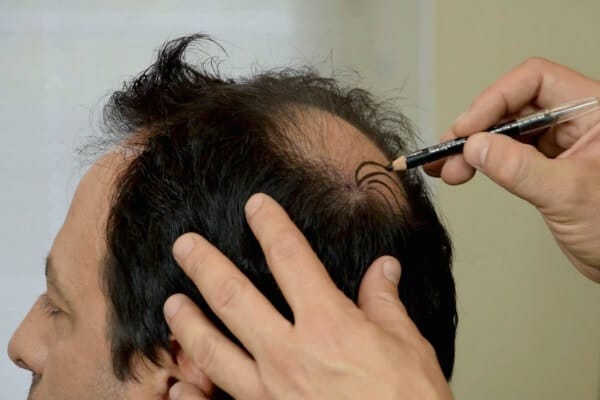
Vertex (Crown)
The vertex, or crown, is typically the highest point of the skull when the head is tilted forward. In hair transplantation, the vertex refers to the posterior section of the balding scalp, extending from the concave posterior border of the midscalp to the beginning of the permanent occipital hairline.
The vertex shape is generally round or elliptical, and its anterior border should mirror the shape and size of its posterior border (mirror image). Rarely, the vertex may have an hourglass shape.
Το ChatGPT είπε:
 0
0