

Beard Transplant – Everything you need to know

Facial hair follicle transplantation involves the beard, mustache, chin, and sideburns. As one might expect, beard transplantation is the most popular.
Restoring Masculinity and Confidence with Modern Beard Transplantation
Facial hair has long been recognized as a defining element of masculine identity and personal style. Beyond its aesthetic value, a well-defined beard can project confidence, maturity, and strength—qualities that many associate with leadership and charisma. According to scientific studies, men with facial hair are often perceived as more masculine, dominant, and self-assured, while also being rated as more attractive and socially influential compared to those with a clean-shaven appearance.
However, not every man is able to naturally grow a thick, even beard. Genetics, hormonal factors, scarring, or certain medical conditions can result in patchy or sparse facial hair, leaving some areas of the face thin or completely hairless. In these cases, facial restoration through beard transplantation provides a highly effective and permanent solution.
A beard transplant involves the careful transfer of healthy hair follicles—most commonly from the back of the scalp—to the areas where beard growth is lacking, such as the cheeks, jawline, mustache, or sideburns. The transplanted follicles continue to grow naturally for life, providing consistent and realistic results. Each follicle is placed with meticulous precision, taking into account the angle, depth, and natural direction of beard hair growth to ensure an authentic appearance.

Design: A Fundamental Step in Facial Hair Restoration
The design process is one of the most critical stages in beard transplant The doctor must act as both a medical specialist and an artist—replicating nature as faithfully as possible while enhancing each patient’s unique facial structure. A well-planned beard design harmonizes with the patient’s bone structure, skin tone, and aesthetic goals, resulting in a balanced, natural look that complements the rest of the face.


Thanks to modern techniques and the use of microsurgical instruments, beard transplantation today is minimally invasive, virtually painless, and delivers permanent results. Within just a few months, patients can enjoy a full, dense beard that can be trimmed, shaved, and styled just like natural facial hair.
In essence, modern beard transplant surgery is more than just a cosmetic procedure—it’s a transformation that enhances both appearance and self-confidence, helping men regain a stronger, more defined sense of self.
Exploring the Primary Causes of Beard Hair Loss and Thinning
- Injury to the area and subsequent healing (with or without stitches)
- Medication or surgical procedures that resulted in the loss of facial hair
- Systemic or localized diseases that caused facial hair loss (e.g., alopecia areata)
- Trichotillomania (compulsive hair pulling)
- Genetic or hormonal factors leading to sparse facial hair or complete absence of beard growth.
Beard Transplantation for Aesthetic Enhancement and Facial Harmony
Some people choose to undergo a beard transplant for aesthetic reasons, primarily to enhance density in the area depending on the style they wish to adopt. Typically, those who opt for beard transplantation are individuals with very fine or sparse facial hair (beard or mustache) who want a fuller look, or those who wish to cover a scar.
However, there are also congenital conditions that affect hair growth in the area, such as atrichia, hypotrichia, or anisotrichia.In all cases—regardless of the underlying cause—patients seeking beard transplantation usually ask for a “thicker mustache”, “fuller beard”, or a “more defined goatee”.
Ideal Candidates for Beard Transplantation and Facial Hair Restoration
Individuals affected by scarring alopecia on the face are often excellent candidates for a beard transplant. This condition, which can result from injury, burns, surgical procedures, cleft lip or palate repair, or even chronic folliculitis, may lead to areas where facial hair no longer grows naturally. Through a beard hair transplant, healthy hair follicles are carefully extracted—usually from the scalp—and implanted into the beard area to restore natural density and shape. This precise and effective procedure allows patients to regain a full, well-defined beard with natural-looking beard hair growth.

There is also a small percentage of individuals who experience thinning in the beard area due to traction alopecia (e.g., from tight styling such as “dreadlocks” in the beard).
Assessing Suitability: The Evaluation Process for Beard Transplant Candidates
The first factor a doctor should consider is the patient’s age, as full beard development in men typically occurs around the age of 30. Therefore, a younger age may actually be a contraindication. Additionally, the reasons behind the patient’s desire for a beard transplant must be explored and evaluated—specifically, whether the patient fully understands the procedure or whether an underlying psychological condition may be influencing the decision.
It is also important to consider ethnic differences in beard density. For example, individuals from India and the Middle East tend to have very dense beards, while Caucasians and Africans generally have moderate density. The lowest beard density is usually observed in East Asian populations—although exceptions do exist.
Finally, the patient’s expectations must be realistic. For instance, a person with naturally sparse facial hair (hypotrichia) may require up to 2,500 grafts for full coverage of the entire beard area—something that may be impractical or even prohibitive.
Beard Transplant Candidate Evaluation at Anastasakis Hair Clinic
The doctor must perform a full medical evaluation, looking for any condition that could pose a risk to the patient’s health or compromise the outcome of the procedure. Certain diseases—such as mumps, diabetes, or blood clotting disorders—are considered serious contraindications.
In addition, a careful examination of the donor area is conducted to rule out skin conditions that could be transferred to the facial area during the transplant, potentially causing issues such as psoriasis, vitiligo, or acne.
How Is Beard Transplantation Performed at Anastasakis Hair Clinic
Beard transplantation is a highly demanding aesthetic procedure, mainly because it involves restoring an area that is in direct visual contact with everyone. In such a transplant—though this applies to all types of hair transplantation, regardless of the area—the medical team at our clinic is called upon to replicate nature as faithfully as possible. Our goal is a completely natural result that goes unnoticed.
The first step in a successful beard hair transplant is precise design, based on the unique facial features of each individual patient. Typically, single-hair grafts are harvested using the FUE technique from the permanent hair zone of the scalp. The follicles selected from this area are those with darker, thicker hairs so that they resemble the natural texture of facial hair, which is usually coarser than scalp hair.
However, in cases where only a small number of grafts are required, the follicles may be harvested from the area beneath the chin and neck, provided that region is dense enough to serve as a donor area. In fact, this approach offers the advantage of using hair with the exact same texture and color as the natural beard hair.

Beard transplantation requires experience, precise technique, and specialization. Depending on the area to be covered, the doctor will use a different number of grafts in order to achieve a natural-looking density. An important and critical detail in both the creation of the recipient sites and the placement of the grafts is that the angle of hair growth varies across different parts of the face. The direction, depth, and angle of the recipient sites and the graft placement are adjusted according to the nine distinct facial zones, and even within each zone individually, to ensure the result is not only dense but also completely natural in appearance.

Beard Transplantation: The Post-Operative Course and Recovery Process
Beard transplantation is a highly refined and specialized form of hair follicle transplantation, designed to restore natural and permanent hair growth. Just like in scalp hair transplantation, the results of a facial hair transplant are lifelong. The transplanted hairs grow naturally and can be shaved, trimmed, or styled exactly like the rest of your facial hair, offering complete freedom and authenticity.
Immediately after your beard transplant, you will receive a detailed set of post-operative care instructions, as well as a complete aftercare kit with everything required to ensure proper healing and optimal results. The first few days after surgery are crucial for maintaining cleanliness and protecting the newly implanted hair follicles.
During the recovery phase, gentle cleansing of the treated area helps remove any residue and prevents irritation. By approximately day 10, all small scabs from the grafted follicles will have cleared, revealing smooth skin underneath. The initial shedding phase that follows is a normal part of the healing process.
New beard hair begins to grow at around four months post-surgery, gradually becoming denser over time. By nine months, you will be able to see a clear and well-defined picture of your final result—natural, even, and permanent beard growth that blends seamlessly with your existing facial hair.
At Anastasakis Hair Clinic, we follow a structured follow-up protocol to ensure every patient’s recovery and results progress as expected. This includes 2–4 visits within the first month, followed by additional check-ups at 1, 3, 6, and 12 months.
Whether performed using the FUE beard transplant method or other advanced techniques, every procedure is tailored to the individual, ensuring optimal graft survival, natural density, and long-lasting satisfaction.
In essence, beard transplant is not only a medical procedure but also a personalized journey toward restoring confidence, masculinity, and balance to your appearance.
Beard Transplantation Overview and Final Thoughts
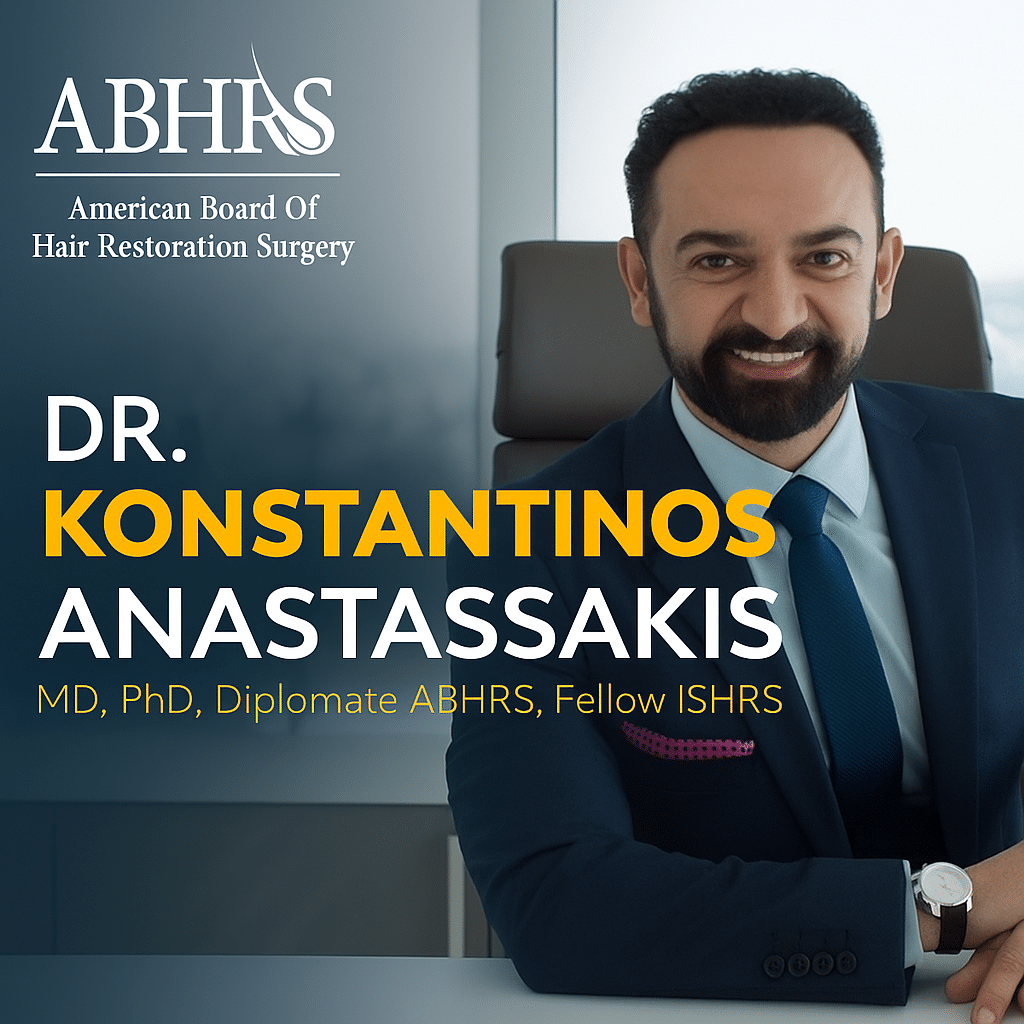
If your beard is sparse or difficult to grow due to genetic factors, scarring, or past trauma, modern facial hair transplantation offers an effective and permanent solution. A beard transplant can restore natural-looking hair growth to areas such as the sideburns, cheeks, jawline, and mustache, enhancing your appearance and confidence. Using advanced techniques and meticulous design, Dr. Konstantinos Anastassakis and his experienced team ensure results that blend seamlessly with your natural beard hair.
If you’d like to find out whether you are an ideal candidate for a beard hair transplant, contact Dr. Konstantinos Anastassakis today at +30 210 80 11 000, or submit your photos and details using our free online evaluation form. You’ll receive a personalized assessment and expert guidance on the best treatment plan for your facial hair restoration.
 0
0