

The punch graft technique is an outdated method of treating thinning and hair loss.
Punch Grafts: Basic Concepts You Need to Know
- The technique introduced by Orentreich, called the punch graft technique, was based on the removal of cylindrical grafts with a diameter of 4 mm. The donor area was left to heal by secondary intention, while in the recipient area, 3.5 mm scalp segments were removed to accommodate the punch grafts.
- The disadvantages of this method were numerous, but desperate patients with hair loss endured them. Since the method was proposed by Orentreich—whose scientific stature was monumental—its use continued for three decades without serious challenge.
- The results in the recipient area were unnatural: hair grew in tufts (doll’s hair), the scalp surface became irregular (cobblestoning), losses during transfer exceeded 50%, recipient sites destroyed useful existing follicles, and the transplanted hair could not be styled naturally.
- The donor area was irreparably damaged, leaving a “shotgun” appearance, with significant postoperative problems and complications, and unnecessary destruction of adjacent follicles, leading to donor exhaustion long before satisfactory cosmetic results could be achieved. Nearly all patients who underwent this technique (>1,000,000) today use wigs and seek corrective hair transplantation, which fortunately can often restore a more natural—even if thinner—appearance.
In Orentreich’s early experiments, follicles were transplanted using cylindrical grafts 6–12 mm in diameter harvested with trochars from the occipital scalp, which were then placed into recipient sites of the same size. In these large grafts, follicle loss was observed in the center, as oxygen could not diffuse from the periphery to the core, resulting in the so-called “donut” effect: cylindrical grafts with hair growth around the edges but bald centers due to central tissue anoxia. To avoid this, smaller grafts were needed. However, the mistaken impression that reducing graft size would make the procedure “aesthetically less worthwhile” discouraged reducing their diameter.
After much experimentation, the 4 mm punch graft became the standard. Some argued that 5 mm grafts continued to show the “donut” effect, while 4.5 mm grafts wasted more donor tissue due to spacing needs. In reality, the final decision to standardize 4 mm grafts was based on economic and technical reasons: the same dermatologic biopsy punch could be used for hair transplantation, minimizing costs.
For decades, punch grafts were the most popular hair transplantation method, with over 1 million patients treated until 1993, when the technique was essentially abandoned. Unfortunately, most of these patients today must wear wigs to conceal the unsightly results, reinforcing the negative social image of the “Hair Transplantation Industry.”
The technique employed by Orentreich and the many dermatologists he taught, with great collegial generosity, was the so-called open donor method. Using a 4 mm trochar, grafts were removed from the occipital donor area. Later, for speed, the trochar was replaced with an electric drill, similar to a household drill, with a rotating steel or later carbon-steel tip.
A slightly smaller trochar (3.5–3.75 mm) was then used to create recipient sites, removing balding scalp tissue. This size difference accounted for the natural contraction of harvested grafts (due to fibrosis) and the expansion of recipient sites (due to loss of elasticity). Grafts were placed into the recipient sites, and both donor and recipient areas healed by secondary intention, without suturing.
The disadvantages of this method were overwhelming and clearly outweighed its benefits. However, the fact that the technique was introduced and championed by Orentreich—whose contributions to dermatology included pioneering work with injectable corticosteroids, injectable silicone, and hormone therapy for alopecia—likely explains why 4 mm punch grafts persisted for decades despite their obvious shortcomings.
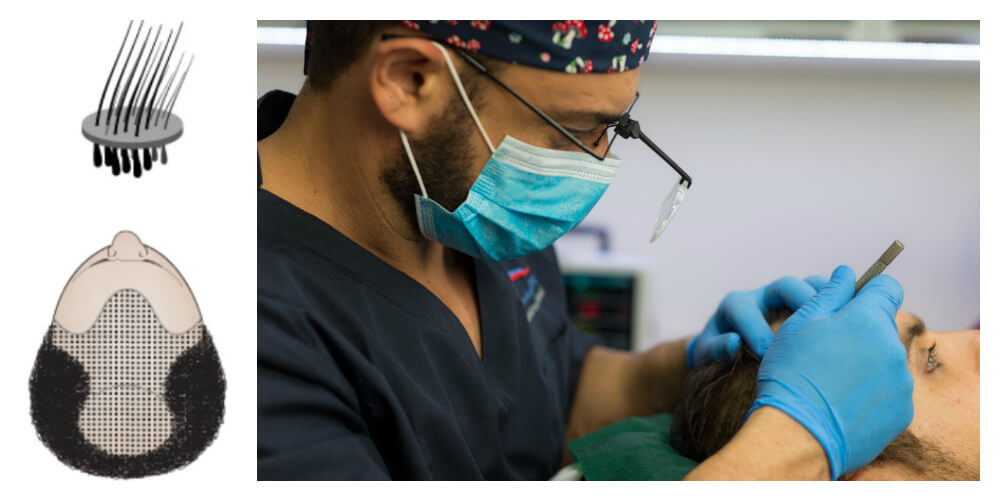
The main disadvantages of the punch graft method were the following:
- This technique resulted in a cosmetic appearance of hair similar to a doll’s head (doll’s hair) at the hairline, meaning the hair appeared to grow from the scalp in small bundles (plugs). The aesthetic outcome was completely unnatural and essentially stigmatized the patient, since the scalp showed dense hair growth at the graft sites but was completely empty in between, which in no way resembled a natural hair pattern. At the same time, the fact that some inexperienced surgeons did not align the grafts so that the hair direction was forward, resulted in the “plugs” of hair growing in different directions, making it impossible to comb the hair. On the contrary, at the crown, punch grafts under ideal conditions gave satisfactory results in terms of density, but not naturalness, since they could not replicate the natural whorl of hair at the vertex, which is an inherited characteristic.
Το ChatGPT είπε:
The lesser of two evils
Simply reducing the diameter of the punch was not practical, as it caused proportionally more damage to the hair follicles than a larger punch, since more follicles in the donor area were injured due to the greater number of incisions required to extract the necessary grafts. Pouteaux was the first to describe the use of punches with diameters of 1.5mm, 2mm, and 2.5mm, but his technique never became popular.
Noteworthy was the radical approach to treating frontal hair loss using a straight occipital graft, first published in 1964 by Vallis, which would later, after 20 years, evolve into the “strip excision” technique. Some early attempts to reduce the size of the grafts after extraction (by dividing the cylindrical graft into 2 or 4 sections) initially failed miserably, as further handling of follicles already damaged by the trochar further reduced the number of surviving follicles. Later, when it was understood that careless surgical handling was the main cause of follicle loss after graft preparation, this method was applied with considerable success regarding the aesthetic outcome of the recipient area, with sessions of 60–100 x 4mm grafts being reported up until 1984.
The most important step forward in the evolution of hair transplantation came when some surgeons decided to suture the 4mm donor site defects.
This attempt was not immediately successful, as the surrounding skin would stretch and alter the direction of hair growth, making later graft extraction from the area difficult or even impossible. However, the simultaneous need to also utilize the islands of tissue between the grafts led to the following “creative” idea for the time: cutting the remaining island after graft extraction and suturing together the two serrated edges.
The technique that involved surgical wound closure and healing by primary intention was initially called the “double row parallel,” and later its refinement became known as the “cluster technique.” This method also included extracting additional grafts from the removed island until all the follicles left from previous extractions had been harvested.
A similar method that was tested was the in situ extraction of grafts in parallel rows without leaving bridges between them, resulting in minimal overlapping of the grafts and therefore the final shape not being exactly cylindrical. However, postoperatively, it produced a more natural aesthetic result in the recipient area.
Another modification that was applied was the use of square grafts, harvested with a handmade square trochar, with the advantage that the square graft provided 25% more follicles per 4mm graft. This becomes clear if we look at geometry, since the area of a circle with radius r equals πr² = 3.14 × r², while the corresponding area of a square is A = diameter² = (2r)² = 4r² (diameter = 2r). The difference in the required donor area is evident when grafts are harvested leaving islands between them versus when the same number of grafts are taken in sequence and the wound is sutured. Unfortunately, this technique too was particularly painful for the patient, and the aesthetic appearance of the recipient area did not differ from the look produced by punch grafts.
These modifications to the classic punch graft technique had two important consequences:
-
The island removed from the donor area became a piece of free tissue, which was then cut into smaller parts, each serving as a graft.
-
According to Pierce (1979), if the incision was performed carefully, the suture of the two edges would result in a scar that was almost imperceptible, even upon close inspection.
With these two discoveries, even a casual, non-specialist observer would raise the question of whether punch grafts were necessary at all. Why not avoid all the disadvantages of punch grafts and simply remove a strip of scalp from the occipital area, divide it into smaller pieces, and suture the edges with minimal scarring and complications?
This reasonable question was answered in practice 30 years later, as the open punch graft method was abandoned and replaced by the strip excision technique, which allowed the creation of minigrafts and micrografts from the further preparation of that strip. At the same time, many other changes and improvements were introduced, such as in surgical instruments, hairline design, donor area management, and more.
Punch Grafts Method: But why so much trouble?
Unfortunately, hair transplantation in the West started off in the wrong direction. While in the 1960s punch grafts began to be used, as early as the 1940s in Japan micrografts were already being employed — grafts containing 1–4 follicles. If the West had been “informed” earlier about this technique, millions of patients would have been spared disfiguring surgeries.
It took more than two decades for Western surgeons to realize the obvious advantage of smaller grafts, and yet another decade before their use became widespread. However, as early as 1943, Hajime Tamura had warned in his publication: “The size of the graft should be as small as possible. The reason is that if the graft is large, the hair grows in a very unnatural way.” Sadly, when Western medicine decided to “reinvent the wheel,” it did so the wrong way! Had more attention been paid to the words of the Japanese pioneers of hair transplantation, decades of disagreements among surgeons, countless poor results on patients’ heads, and the irreparable tarnishing of an entire field of medical science could have been avoided.
Unfortunately, some surgeons still use the outdated punch graft method — at least in certain areas of the recipient zone — for reasons of convenience and speed. Today, however, this practice is utterly unacceptable and must be condemned.
I have undergone punch grafts. What should I do?
Unfortunately, most of these patients today are forced to wear a wig in order to cover the unacceptable aesthetic results of the punch graft technique. Even for the very few patients who were satisfied, it is remarkable that satisfaction with the same surgical outcome changes over time and ultimately depends heavily on the subjective comparison with the results of other people who underwent the same or similar procedure.
A study by Farber et al. on patients who underwent hair transplantation with punch grafts between 1965–1972 reported that 80% of them were more than 75% satisfied with the outcome of their surgery. In contrast, a publication by Adler et al. in 1999, which compared patient satisfaction between older and newer hair transplant techniques, showed significantly reduced satisfaction among patients who had undergone punch grafts. Observing the naturalness of the results achieved with modern hair transplant techniques, these patients shifted the “bar of what is possible,” raising their expectations and making what was once a satisfactory outcome now unacceptable.
Today, with aesthetic standards approaching perfection, all former punch graft patients are seeking a reliable hair transplant surgeon to correct what was once considered an acceptable result but is now, justifiably, deemed unacceptable — even in countries such as India.
Written by Dr. Konstantinos Anastassakis
 0
0