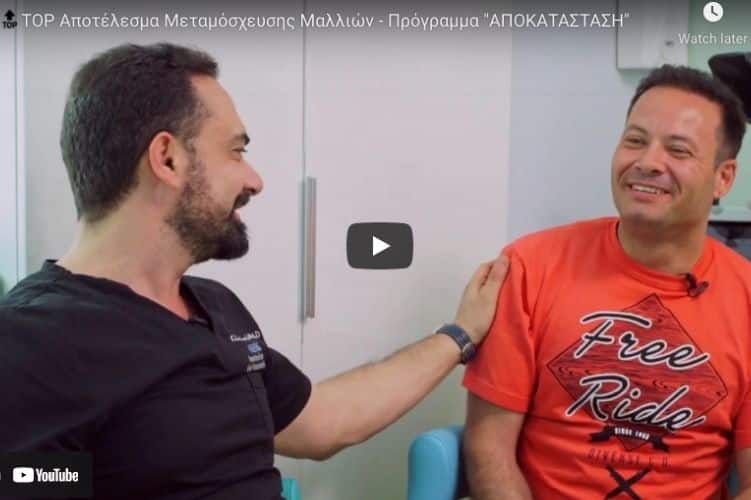


“I’ve already had—not just one—but five hair transplants!”
When you hear something like that, you naturally expect to see a head full of thick, dense hair.
But if that’s not the case, it definitely makes you wonder:
Why five? And more importantly — where is the hair?
Learn the Truth About Hair Transplant Scams
Spyros visited Anastasakis Hair Clinic hoping to find out if anything could be done in his case — because the results after five hair transplant procedures were far from what he had expected.
His story is both eye-opening and, unfortunately, not unique. There are many others who have found themselves in a similar position — even though they never should have.
It all began three years ago, when Spyros visited one of the most well-known hair transplant clinics. After receiving a consultation, he decided to go ahead with his first transplant. The package he was offered was incredibly appealing — and came at an unbelievably low price.
They promised him a lifetime “golden guarantee”: they would keep transplanting hair follicles until the bald area was fully covered. And all of this for just €1,500!
After the Transplant: What Really Happened
After the first transplant, when Spyros realized the results were far from what he had expected, he returned to the clinic. They reassured him that, thanks to their “lifetime guarantee,” they would perform another hair transplant free of charge.
That’s how he didn’t end up with just two — but five hair transplants. Each time, the outcome fell short of expectations… but luckily, he had the “golden guarantee.”
At first glance, this might seem like excellent after-sales service.
But the reality is very different.
In Spyros’ case, the result after five procedures was extremely sparse coverage — and even worse, his donor area was completely destroyed.
As clearly visible, the FUE procedures he underwent left behind widespread scarring, making his donor area look patchy and moth-eaten. They may have promised to keep implanting grafts until full coverage was achieved, but they failed to consider a crucial fact:
Donor follicles are not unlimited.
Why Did This Happen?
Why did Spyros — like many others — end up with such poor results and so little hope for future improvement, due to an overharvested and damaged donor area?
“It all starts,” explains Dr. Anastasakis, “with the fact that in most so-called ‘clinics’ performing hair transplants in Greece, these procedures are not carried out by licensed doctors. In many cases, they’re done by unqualified individuals with no connection to the medical field — not even nurses. Worst of all, these individuals often pose as doctors when in reality, they are not.”
That’s exactly what happened to Spyros. He told us the person who performed his transplant introduced himself as a doctor, but Spyros was immediately skeptical — “He didn’t seem like a doctor at all.”
And that became painfully obvious later.
The assessment of his needs and the strategy for his hair restoration were completely flawed and misleading. A qualified hair transplant surgeon has the knowledge and experience to evaluate each case individually — whether surgery is appropriate at that moment, whether medical treatment should be considered first, how many grafts are needed for proper coverage, and how many can safely be extracted from the donor area.
The approach Spyros received —
“We’ll keep adding grafts until the area is full”
— is not how a responsible doctor operates.
The FUE Myth and the Damage It Can Cause
All five of Spyros’ procedures were done using the FUE method — a technique often performed by non-doctors under the misconception that “FUE doesn’t require medical knowledge.”
But if the person extracting grafts from the donor area lacks medical or anatomical expertise, they simply cannot ensure the survival of the follicles or their regrowth in the recipient area.
If the follicles are damaged during extraction, they won’t grow hair — no matter where they are placed.
Can You Protect Yourself from This?
“Unfortunately, no,” says Dr. Anastasakis.
“These situations happen because of a legal loophole — not only in Greece but in many countries around the world. There is no legal framework to prevent this. Even if a complaint is filed, if the person isn’t a licensed physician, there’s no medical license to revoke, no medical board to expel them from.
They can just keep doing what they’re doing.”
The only real defense is proper public awareness — and this is exactly what responsible hair restoration professionals are trying to promote.
The Global Fight Against Hair Transplant Fraud
That’s why the International Society of Hair Restoration Surgery (ISHRS) launched the global awareness campaign “Fight the FIGHT”,
which stands for:
Fraudulent, Illicit & Global Hair Transplants.
Its mission is to combat the growing epidemic of unlicensed, non-medical practitioners performing surgical hair transplant procedures around the world.
“Patients are lured into these illegal clinics through deceptive advertising,” the ISHRS warns,
“with promises of guaranteed results at unbelievably low prices. But in doing so, they put their health at serious risk and often suffer irreversible damage with little to no chance of repair.”
Members of the ISHRS report seeing patients with a wide range of issues after visiting such clinics, including:
- scarring
- unnatural hairlines
- poor graft survival
- incorrect hair direction
- overharvested donor areas
- infections
Spyros’ Advice to Others
In hindsight, Spyros now advises anyone considering a hair transplant to beware of “too good to be true” offers.
“If someone is offering you an unbelievably low price, there’s definitely a catch,” he says.
“It’s just that the low cost distracts you from seeing the trap.
In the end, cheap turns out to be very expensive.”
A Fresh Start – The Right Way
Determined to do things right this time, Spyros turned to Anastasakis Hair Clinic.
After being personally examined by Dr. Anastasakis, he was advised to begin with a medical treatment plan, and in about a year, to undergo a FUT hair transplant — the method best suited for his current condition.
The plan includes:
- redesigning his hairline to look natural
- restoring density to areas that should have already been full….after five transplants
 0
0