

In recent years, more and more clinics have been advertising “Hair Transplant Without Shaving!” with remarkable results. Unshaven FUE hair transplants are becoming increasingly popular because they promise patients the ability to go out immediately after the procedure without anyone noticing signs of shaving that reveal they’ve undergone surgery.
But can a hair transplant without shaving truly deliver the impressive results that many clinics claim, or is it just another marketing gimmick? A tactic designed to attract those who want a hair transplant but don’t want anyone to know they had one. Read on to find out what really happens during an unshaven hair transplant session.
How Is a Hair Transplant Without Shaving Performed Using the FUE Technique?
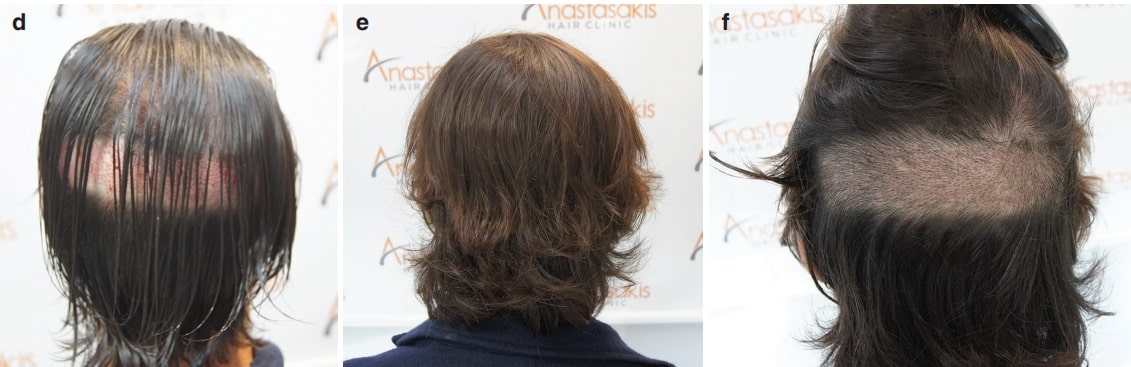
The only technique that does not require shaving the donor area is the FUT method. Regarding the FUE technique, unshaven hair transplantation is performed in the same way as classic FUE, with the key difference that the hair in the recipient and/or donor areas is not shaved and remains almost untouched before extraction.
Unshaven hair transplantation can involve the donor area, the recipient area, or both. There are several variations:
- Shaving only a small section of the donor area: This method typically involves shaving narrow linear strips within the donor area, from which all follicular units are extracted. These shaved strips are then concealed by the surrounding longer hair.
- Unshaven recipient area: In this variation, the hair in the recipient area is not shaved at all, and grafts are implanted between the existing hairs.
- Fully unshaven FUE: Both the donor and recipient areas remain unshaved and intact.
In a typical FUE hair transplant, the donor area is shaved to facilitate graft extraction, and the recipient area is also trimmed to allow for dense graft placement. However, since some patients feel socially uncomfortable with a shaved head, various unshaven modifications are often adopted.
Hair Transplant Without Shaving: What Are Your Actual Options?
One possibility is that the recipient area remains uncut, with the existing hair retaining its full length, while new grafts are implanted between the natural hairs. Regarding the donor area, there is the option where narrow linear sections of 2-3 cm at the back of the scalp are shaved, from which all follicular units are extracted. These shaved areas are then covered by the surrounding longer hair. Additionally, there is a selective follicle isolation method, resulting in a partial no-shave transplant, where only the follicular units to be extracted are trimmed in the donor area.
So, can hair transplantation without shaving deliver the successful and impressive results of the classic FUE technique, or is it just another marketing gimmick? Could it be that the much-hyped no-shave hair transplant isn’t as ideal as it’s often portrayed?
No-Shave Hair Transplant… Debunking the Myth
All the techniques mentioned above, besides being very time-consuming, come with certain drawbacks. These disadvantages affect not only the final result but also the overall appearance of the scalp in both the recipient and donor areas.
For example, when graft extraction is not done strategically across the entire donor area but instead follicular units are harvested en masse from a specific section, there is a high risk of creating an unnatural pattern in the donor area—with alternating dense and sparse linear or square patches.
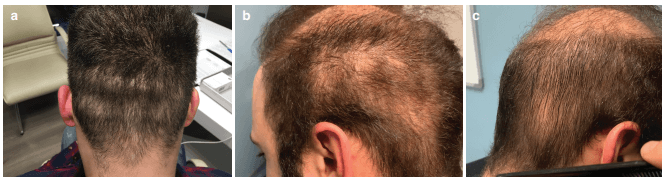
And while theoretically the no-shave hair transplant is performed so that no one can tell you’ve undergone a transplant, in reality, such an appearance in the donor area can be anything but unnoticeable.
What you should always keep in mind is that this kind of damage to the donor area is very difficult to conceal because the follicular units removed cannot be naturally replenished, leaving the area looking patchy or “moth-eaten.” Normally, with the FUE technique, the entire donor area is shaved down to about 1-2mm in length. Partial or segmented shaving of the donor area usually results in inferior outcomes and should not be recommended unless the surgeon has significant expertise with this specific method.
.
Other Reasons Why No-Shave Hair Transplant May Negatively Impact Results
When graft placement is performed in a recipient area where the surrounding hair remains at full length, several challenges arise:
- Creating recipient sites takes significantly longer because the surgeon lacks full visibility and a “clear field” to work freely, requiring more time to locate a viable and safe space between existing hairs.
- Inserting grafts into these sites is also more time-consuming for the same reason. Additionally, there is a risk that when placing a graft, an adjacent hair may be pulled along and pushed under the skin, causing complications.
- Some clinics promote the direct implant technique, where the recipient site is created simultaneously with graft insertion during an unshaven session. However, the reality is that the risks remain the same — the site may not be created in a free space, could be made on top of an existing follicle, or may drag nearby hair under the skin — because the surgeon’s visual field remains restricted.
When no-shave transplantation involves only a small shaved portion of the donor area from which all grafts must be harvested:
- A noticeable bald patch remains after extraction, which is difficult to conceal with surrounding hair.
- Separating and sorting grafts becomes more challenging and time-consuming, especially when distinguishing between single-hair and multi-hair follicles.
- This limits the variety of grafts available. For example, one small area might contain more single-hair follicles than multi-hair ones, which are often needed to achieve density. Thus, the choice of donor site becomes more of a gamble than a strategic decision, potentially impacting the overall result.
In summary, while no-shave hair transplants may sound appealing, these technical challenges can compromise the quality and naturalness of the outcome.
No-Shave Hair Transplant: Postoperative Care
Besides the final result, which can be influenced by various factors, postoperative care of both the recipient and donor areas becomes more complex and requires extra attention in no-shave hair transplants. This is because the existing long hairs can either get tangled and “push out” the newly transplanted grafts or make it harder to properly clean the treated area.
From the above, it’s clear that no-shave hair transplantation involves several technical challenges that, if not handled by an experienced specialist, can easily compromise a good outcome.
When Is a No-Shave Hair Transplant Recommended?
Not all patients are suitable candidates for a no-shave hair transplant, and even fewer can truly benefit from this technique. Generally, this method can be successfully applied only in specific cases where it can deliver the desired results. So, what are these cases?
- Patients requiring a limited number of grafts who have an exceptionally dense donor area.
- Women or men with relatively long hair—provided they don’t need many grafts—so that the existing hair length can effectively conceal the so-called “zebra effect.”
Hair Transplant for Guaranteed Results
The most essential prerequisite for a successful no-shave hair transplant is the extensive experience and technical skill of the hair transplant surgeon and their nursing team. Only when every step of the hair transplant procedure is executed flawlessly can the outcome be equally perfect.
If you’re considering a hair transplant, take the first step today!
Turn to a doctor who will provide you with honest, scientifically sound information. Don’t be swayed by empty promises or those who say “yes” to everything! Seek out a specialist whose scientific expertise and experience guarantee comprehensive, reliable advice—free from unethical marketing tactics designed solely to exploit you financially… and then we’ll see about the results.
For responsible and thoroughly professional guidance on hair transplantation, we’d be happy to answer any questions and help you find the best method tailored to you. Book a consultation, and Dr. Anastasakis, with a strategy tailored to your needs and level of hair loss, will help you make the right decision—one that will have you smiling confidently at your reflection.
An amazingly dense hair transplant result without shaving using the FUT technique.
 0
0