

Written by Dr. Konstantinos Anastasakis, MD, PhD, Democritus University
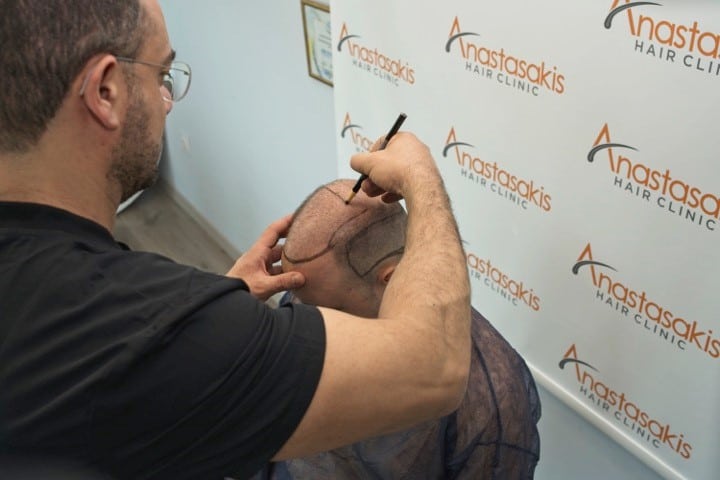
The hair transplant services offered by my clinic are complex, and as a result, patients always approach them with a genuine desire to learn. To date, the three most common questions in hair transplantation are:
- Am I a suitable candidate for a hair transplant?
- How many grafts will I need to cover my current hair loss?
- Will there be enough grafts available for the future if my hair loss progresses?
When patients ask these questions, it reflects a mature and thoughtful approach to restoring their appearance.
These are exactly the questions that the surgeon must also answer for themselves before undertaking a patient’s hair restoration journey!
How do these common questions impact us in Hair Transplantation?
The answers to these questions will determine the STRATEGY that the surgeon will design.
A sound and ethical scalp restoration strategy must be long-term and never short-sighted, aiming only to “plug holes” in the present moment!
All these, along with other concerns related to the overall strategy, can be answered with absolute accuracy and reliability through a detailed and thorough examination of both the donor and recipient areas of each patient individually.

One must remember that for the patient, the most important area of the scalp is the recipient area — the area affected by hair loss and the primary reason they come to my clinic.
For me, as a hair restoration surgeon, the most important area is the donor area.
Therefore, both areas must be given equal importance during the physical examination.
Why is a surgical strategy essential in Follicular Unit Transplantation?
The follicular units in the donor area are not infinite and are almost always significantly fewer than what would be needed to cover all of the patient’s thinning areas—both current and future. Therefore, managing the donor area requires prudence and artistic skill. Ethical and precise management of the donor area begins with the principle that the surgeon will transplant only the necessary number of follicular units to provide natural and complete coverage—and not a single graft more!
Hence, the purpose of the meticulous measurements performed at Anastasakis Hair Clinic is to accurately calculate the exact number of grafts needed to achieve coverage without wasting the donor area unnecessarily, avoiding needless trauma and expenses, while simultaneously preserving “reserve” grafts for the future, should they be required!
Donor Area Examination: General Principles
At Anastasakis Hair Clinic, I follow these steps during the patient’s physical examination to obtain the most accurate data:
‣ I touch and assess the texture and feel of the hair in both the donor and recipient areas.
‣ I evaluate the elasticity and mobility of the donor area by touch — essential parameters when choosing the FUT technique or the Combo technique (FUE + FUT)

Donor Area Assessment: Detailed Procedure
At Anastasakis Hair Clinic, I perform the following detailed assessments during the donor area examination to ensure the best results:
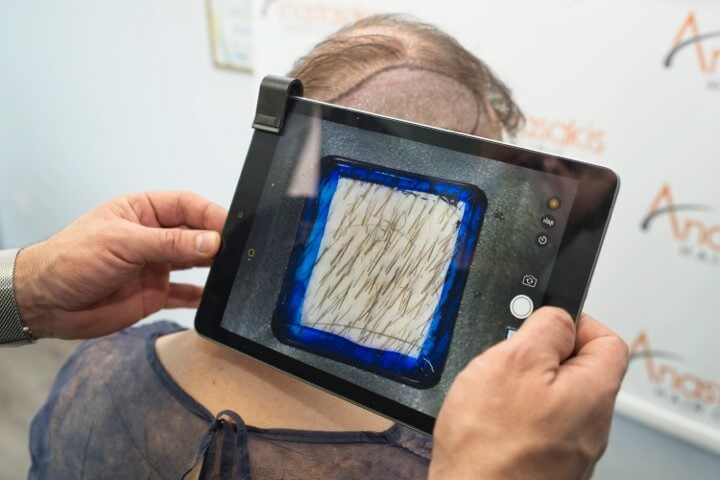
- I measure the follicular unit density in the donor area using a digital microscope (follicular density). This essential step helps me determine the safe number of follicular units that can be extracted in a single session, as well as the total number that can be harvested in the future (donor capacity).
- I measure the surface area of the donor region to calculate the exact number of follicular units to be extracted from each sub-area. This is crucial for maintaining uniformity in the donor area after extraction, avoiding patches of varying density or visible micro-scars.
- I measure the hair density within the follicular units in the donor area (calculated density). Since intact follicular units are transplanted—especially with the FUE technique, where I can select which grafts to extract—this measurement is critical. It allows me to identify how many multi-hair grafts need to be harvested from each area, maximizing hair count while using the same number of follicular units, resulting in a denser final outcome.
- I evaluate hair parameters such as diameter, ellipticity, color, and contrast with the scalp. The average hair diameter is the most important factor influencing coverage in hair transplantation. Specifically, hair thickness has approximately 2.5 times greater impact on coverage than the absolute hair count. Measuring the average hair diameter is necessary to understand the actual density that can be achieved without wasting grafts.
- I inspect for old scars from previous surgeries or injuries in the donor area.
- I look for signs of hair loss due to alopecia areata, scarring alopecia, or other causes, both on the scalp and body.
- I examine for dermatological conditions such as infections, vitiligo, psoriasis, etc., on the scalp and body.
I take detailed photographs of the donor area with dry hair (and wet hair, if the patient consents) to document the baseline condition.
Recipient Area Examination During Initial Assessment: General Principles
- I measure the surface area of the recipient site to accurately calculate the number of follicular units to be transplanted into each sub-area.
- I assess the density and quality of follicular units in the recipient area using a digital microscope.
- I take detailed photographs of the recipient area with dry hair (and wet hair if the patient agrees at this stage).
- I photograph the designed hairline and the specific areas planned for transplantation.

Donor Area Examination During Initial Assessment: Technical Details
- A macroscopic evaluation of the donor area is performed with the existing hair length, accompanied by photographs taken with both dry and wet hair (if the patient consents).
- The total surface area of the donor region is measured using a digital camera combined with specialized software, and photographs are captured.
- Follicular density is measured in three locations on each side of the scalp (a total of six measurements), with images taken using a digital microscope.
- Calculated density is measured on the digital microscope images using specialized software.
- The average hair diameter is measured in each area (3 hairs from each of the 6 sub-areas, totaling 18 samples) using an analog micrometer.
From the above results, we precisely calculate:
- The overall macroscopic appearance of the donor area and whether any regions already show signs of thinning.
- The total surface area of the donor region.
- The surface area of the six sub-regions within the donor area.
- The exact number of follicular units to be extracted from each sub-region to maintain uniformity in the donor area, based on the calculated follicular density and hair diameter of each sub-region.
- The total number of follicular units that can be safely harvested in a single session.
- The total number of follicular units that can be harvested safely in the future (donor capacity)
Donor Area Examination Immediately Before Follicular Unit Extraction (FUE): Technical Details
- A macroscopic assessment of the donor area is performed with the existing hair length, and photographs are taken with both dry and wet hair.
- The donor area is fully shaved (applicable only for FUE technique and occasionally for the Combo technique), followed by a macroscopic reassessment of the fully shaved donor area, with additional photographs taken.
- A new surface area measurement is performed if necessary.
Recipient Area Examination Immediately Before Hair Transplant: Technical Details
- A macroscopic evaluation of the recipient area is performed with the existing hair length, including photographing the area with both dry and wet hair. The sub-areas to be transplanted are carefully selected.
- In areas with existing hair, I calculate the precise density that needs to be added for full coverage and mark accordingly.
- The recipient area is shaved only if agreed upon with the patient.
Is it really possible to manage something effectively without knowing it thoroughly? Certainly not!
That’s why when you hear things like “Yes, you have thick hair” or “Donor area looks good” without any further detailed information, you should be cautious — because the worst loss won’t be just your money, but the precious follicular units that might be irreversibly damaged in the donor area.
The purpose of the precise measurements taken at Anastasakis Hair Clinic is to calculate the exact number of grafts required to provide effective coverage without wasting donor area resources unnecessarily, while preserving “reserves” of grafts for the future, if needed.
If you want to read more articles on hair transplantation, my blog is regularly updated with new content.
Alternatively, if you think you might be a suitable candidate for a hair transplant, you can book a free online consultation at our clinic to learn about the costs and clear any doubts, or call us at +30 210 8011 000 for assistance.
 0
0