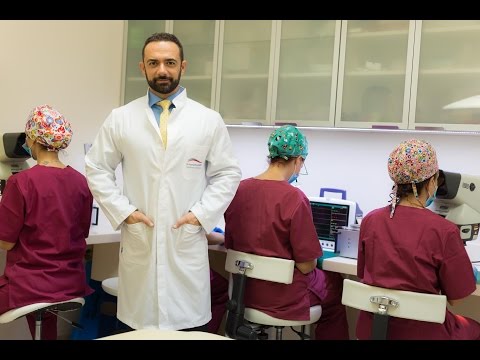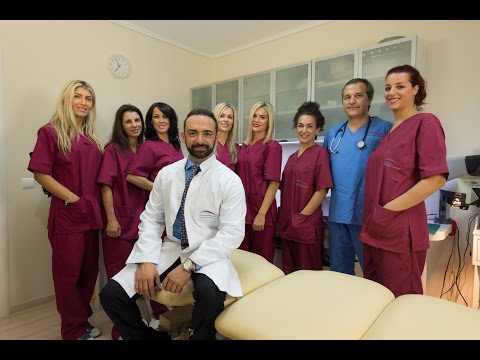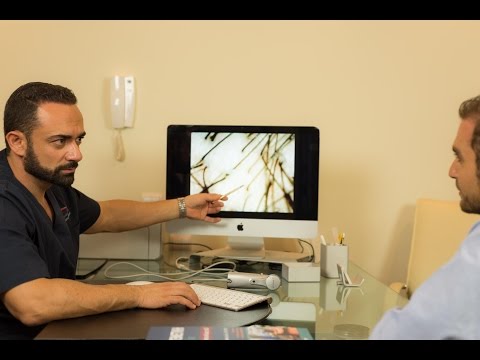


A hair transplant is a surgical procedure that can only be performed in a fully equipped medical clinic, by a specialized doctor and a trained nursing team.
The process begins with preparing the donor area — the back and sides of the scalp, where the grafts are harvested. These grafts never fall out again. If the FUE technique is chosen, the donor area needs to be shaved. If the strip method is chosen, no shaving is required.
Next, in both FUE and strip methods, local anesthesia is applied, and the follicles are extracted — either one by one, or in a strip — without any discomfort. The nursing team then prepares the grafts under high-precision stereomicroscopes, carefully removing any excess tissue so the follicles are as fine as possible.
At the same time, if the strip technique is used, the donor area is closed with the trichophytic closure method — an advanced stitching technique that leaves no gap or visible scar once the suture is removed after 10 days.
Before creating the recipient sites, the doctor checks the grafts to ensure they are perfectly prepared in length and thickness. Designing the recipient sites is the most demanding part of the procedure: each incision must be made at the right depth, angle, and direction to perfectly mimic natural hair growth.
Once the thousands of tiny recipient sites are created, the nursing team begins placing the grafts. The doctor supervises the process to ensure proper orientation, direction, and depth. At this stage, most patients relax by watching a movie — or even fall asleep.
When the placement is complete, the doctor performs a final check. The patient then leaves the clinic with detailed instructions for caring for both the donor and recipient areas in the days ahead, with the first follow-up visit always on the fourth day.
The procedure is entirely painless, thanks to local anesthesia and the specialized techniques we use. It is minimally invasive, so you will not experience swelling or pain — even after the anesthesia wears off. At most, you may feel like you’ve had a late night and woke up with a slightly heavy head. By the very next day, there is no discomfort at all.
From here, the most important thing is to carefully follow the post-operative instructions. The hair transplant is done — and in just a few months, you’ll be enjoying your new results.
 0
0