


Treatment with Minoxidil & Other Therapies
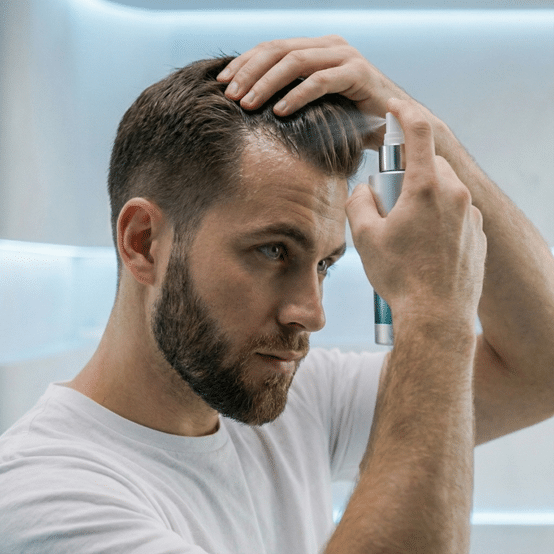
Male and Female Hair Loss
Hair loss—particularly androgenetic alopecia in both men and women—is one of the most common aesthetic and psychological concerns of modern times. Scientific research has identified specific, evidence-based treatments that can slow down or stabilize hair loss.
At Anastasakis Hair Clinic, hair loss treatment is based exclusively on medical evidence, personalization, and realistic expectations.
Are Hair Loss Products Effective?
Today, there are dozens of hair loss products available on the market. With very few exceptions, most of them offer little to no real effectiveness, despite their often high cost. The only treatments worth considering are those that have been clinically tested and officially approved for the treatment of hair loss.
Approved Treatments with Proven Results
To date, the only approved treatments for hair loss with clinically proven results are Minoxidil, Finasteride, and Laser Hair Loss Therapy. These are the only therapies that have demonstrated real effectiveness in the fight against androgenetic alopecia.
All three treatments are supported by numerous extensive studies that confirm their mechanism of action, safety, and efficacy.
Hair Loss Treatment with Minoxidil
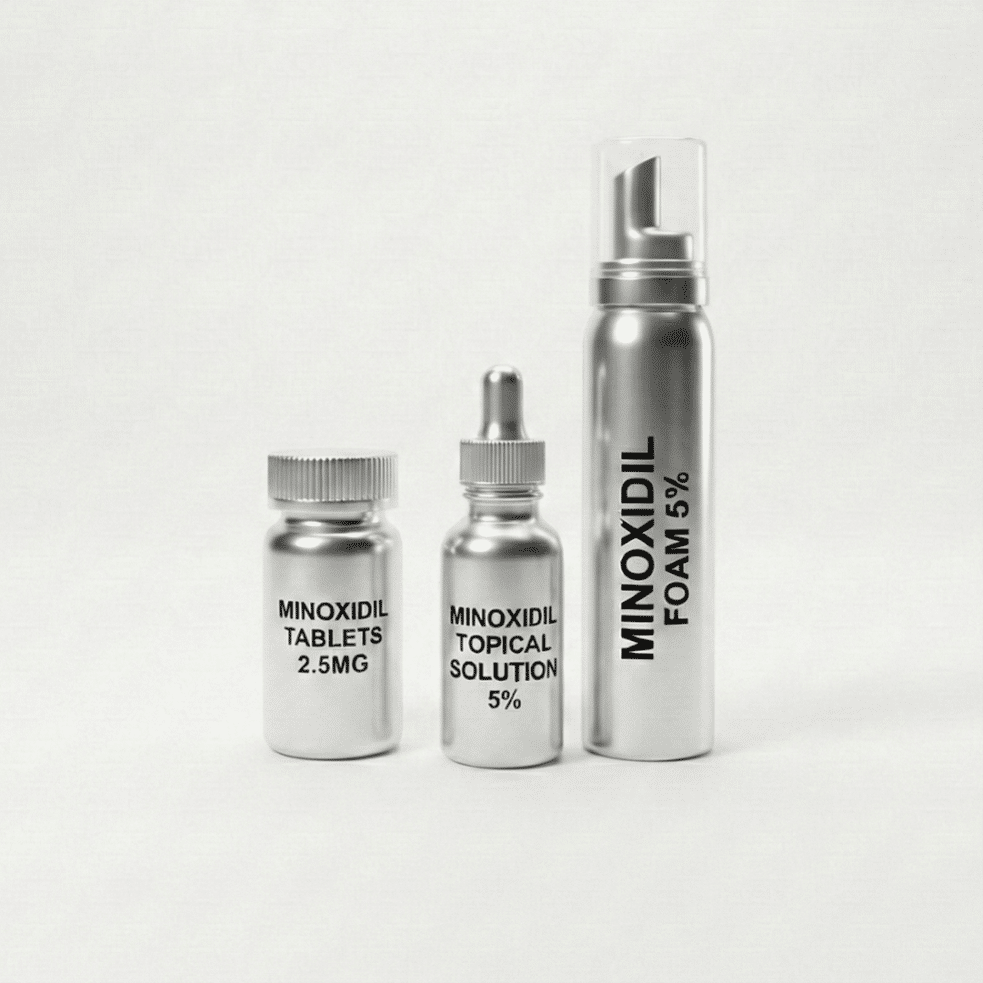
Minoxidil is one of the two globally approved pharmaceutical treatments for androgenetic alopecia. It has been used for decades and has proven effective in both men and women.
It is not a “magic solution,” but rather a continuous therapeutic intervention aimed at preserving and strengthening existing hair follicles..
What Is Minoxidil?
Minoxidil is a pharmaceutical compound that was originally used to treat hypertension. During its use, intense hair growth was observed as a side effect, which led to its study and development as a treatment for hair loss.
Today, topical minoxidil is approved for use in:
- Men, for male androgenetic alopecia
- Women, for female androgenetic alopecia
Forms of Minoxidil and Their Effectiveness
Minoxidil is mainly available in topical formulations, such as:
- Solution (lotion) 2% and 5%
- Foam 5%
It is also available in oral tablet form (systemic administration).
The foam formulation—often prepared as a compounded pharmaceutical product—is frequently preferred due to:
- Better skin tolerance
- Lower risk of irritation
- Easier application
The effectiveness of minoxidil depends on:
- Proper and consistent use
- The stage of hair loss
- The patient’s genetic predisposition
In recent years, there has been growing interest in Low-Dose Oral Minoxidil (LDOM) as an alternative treatment for hair loss in selected cases.
How Do We Know Which Hair Loss Treatment Is Right for Each Patient?
At Anastasakis Hair Clinic, we use Trichotest™, a specialized genetic hair loss test that maps the patient’s genetic profile and provides clear guidance on the most suitable therapeutic roadmap.

With a simple saliva sample, the test analyzes specific genetic markers related to response to treatments such as minoxidil, finasteride, and other approved therapies.
The benefit for the patient is substantial: unnecessary trial-and-error treatments are avoided, valuable time is saved, and a fully personalized treatment plan is followed from the very beginning—based on the individual’s genetic “map.”
Trichotest™ is available exclusively at Anastasakis Hair Clinic, reflecting our philosophy of medical precision rather than generic solutions.
How Minoxidil Works
Minoxidil acts directly on the hair follicle and does not work hormonally. Its main mechanisms of action include:
- Prolongation of the anagen (growth) phase
- Stimulation of the transition from the telogen to the anagen phase
- Improved blood circulation in the scalp
- Enlargement of miniaturized hair follicles
Oral minoxidil works systemically rather than locally and has a vasodilatory effect. Unlike topical minoxidil, its effectiveness does not depend on the skin’s ability to metabolize the drug—explaining why it may be more effective in some patients.
Simply put, minoxidil—in any form—keeps hair with remaining growth potential active.
How Effective Is Minoxidil for Hair Loss?
Minoxidil does not create new hair follicles. However, it can:
- Stabilize hair loss
- Improve hair density and shaft diameter
- Act synergistically with other treatment protocols
Initial results are usually observed after 4–6 months, while maximum results are typically evaluated at 12 months.
As with any hair loss treatment:
- Results vary from person to person
- Continuous use is required
- Discontinuation leads to gradual loss of the achieved results
Laser Hair Loss Therapy (LLLT)

Laser hair loss treatment is known as Low-Level Laser Therapy (LLLT), using so-called “therapeutic lasers.” LLLT is also referred to as red light therapy, cold laser, soft laser, biostimulation, or photobiomodulation.
Laser hair loss therapy has been approved by the U.S. Food and Drug Administration (FDA) for the treatment of both male and female androgenetic alopecia.
LLLT is approved as a safe and effective method for hair follicle stimulation in:
- Men with androgenetic alopecia (Norwood–Hamilton stages IIa–V)
- Women with androgenetic alopecia (Ludwig stages I-4, II-1, II-2)
- Fitzpatrick skin types I–IV
What Results Can Be Expected from LLLT?
- LLLT shows positive results as monotherapy or as an adjunct treatment in the majority of patients with hair loss. Most patients report reduced shedding and improved hair texture and quality.
- Clinical experience indicates that hair regrowth stimulation is more likely when hair loss is at an early stage.
- Continued LLLT as maintenance therapy is necessary after the initial 6–12 month treatment protocol to maintain results.
- After hair transplantation, LLLT contributes to faster hair regrowth in patients who use it during both the preoperative and postoperative periods.
Combining Minoxidil and Finasteride
Minoxidil and finasteride provide enhanced results when used together, as they work through different mechanisms. Finasteride promotes hair growth by blocking the negative effects of DHT, while minoxidil directly stimulates the hair follicle.
There are no adverse interactions between the two medications, and combined use may lead to improved outcomes.
Do Hair Loss Treatments Really Work?
Explore real patient cases from Anastasakis Hair Clinic, featuring individuals who followed pharmaceutical treatment—or a combination of approved hair loss therapies.
A Fundamental Truth About Hair Loss Treatments
There is no definitive cure for hair loss. Every substance used against hair loss is a form of ongoing treatment—meaning results are maintained only as long as the treatment continues.
So, don’t expect to use something for a few months and have hair loss stop permanently.
Important Points About Hair Loss Treatments
- Do not discontinue treatment because someone told you your “skin needs a break.” The skin does not become “tired” of approved treatments.
- Stop treatment only if you experience side effects and after informing your treating physician. You may also stop if hair thinning no longer concerns you.
- Do not stop and restart treatment, as results may be minimal or even negative. If a treatment works for you, continue it daily. Once discontinued, results are quickly reversed.
- Trust your treatment. Increased shedding at the beginning of therapy is a positive sign, indicating that hair follicles are responding.
- Hair grows up to 1.2 cm per month. While some treatments help restore hair, visible results usually appear after 6 months.
Does Everyone Get the Same Results?
Some individuals respond exceptionally well, while others may see more modest results initially. The time required to observe improvement varies from case to case. Since hair loss treatments do not produce immediate results, patience is essential. However, in all cases, treatment should be continued for at least 6 months before results are evaluated.
Most importantly, do not start any hair loss treatment on your own. Choosing the appropriate therapy should never be done without medical guidance. Each type of hair loss has different causes, progression stages, and treatment requirements. Only a specialized physician can accurately assess the condition and recommend the most suitable treatment, prioritizing safety and long-term effectiveness.