


Androgenetic Alopecia
Androgenetic Alopecia
Androgenetic Alopecia (AGA)—also known as androgenic alopecia, male pattern baldness, or female pattern hair loss—is the most common type of hair loss, affecting about 98% of men who lose hair due to this condition. It is also a major cause of hair thinning in women.
The hallmark of AGA is the gradual miniaturization of hair follicles in hormone-sensitive areas of the scalp: the frontal hairline, the crown, and the top of the head. These scalp hairs contain androgen receptors that respond to hormones called androgens, especially the androgen called dihydrotestosterone (DHT). Even though men with AGA do not have higher androgen levels than others, their follicles are simply more sensitive due to factors such as the androgen receptor gene and overall genetic predisposition.
As follicles miniaturize, they produce shorter and thinner strands—finer, lighter, and eventually colorless hairs. The hair growth cycle shortens, new hair grows more slowly, and hair falls sooner. Over time, this leads to gradual thinning, increased scalp visibility, and eventually complete baldness in some individuals. Although women rarely become fully bald, female pattern baldness still causes significant thinning hair on the crown and central scalp.
Classification of Androgenetic Alopecia
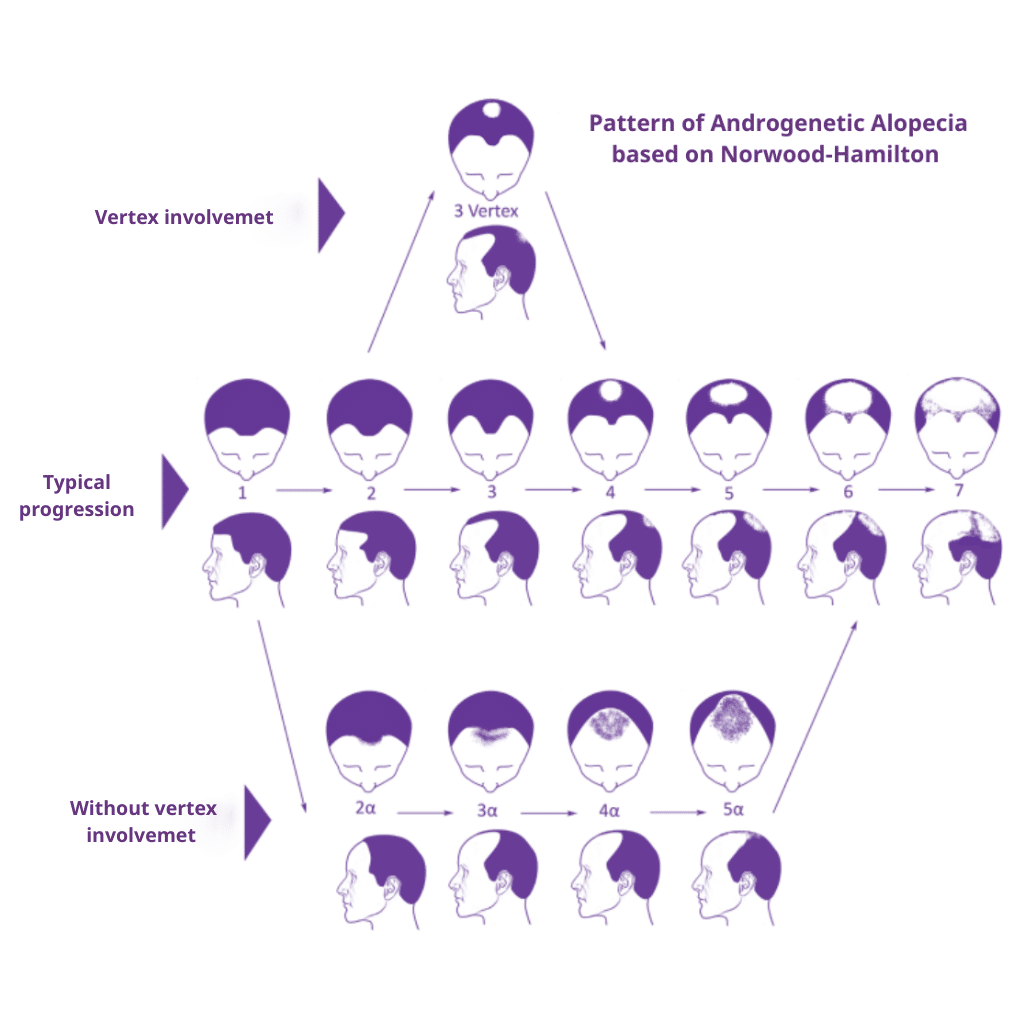
- In men, male pattern hair loss is classified using the Norwood–Hamilton scale, which shows how patterned hair loss appears and progresses.
- In women, the Ludwig scale is used, illustrating the degree of female pattern hair loss on the crown.
Stages of Androgenetic Alopecia
In the table below, you can see the different stages of hair loss. The chart also calculates the approximate number of hair follicles required to be transplanted in order to restore natural hair density in each specific area.

Androgenetic alopecia is a form of hair loss that develops gradually and is mainly caused by the action of androgens on the hair follicles, as well as by genetic predisposition. It is the most common cause of hair thinning in both men and women, significantly affecting appearance and quality of life.
Causes of Androgenetic Alopecia
- Genetic Predisposition
AGA has a strong family history component and is influenced by inherited genes. The follicles of affected individuals are more sensitive to normal androgen levels, which explains why normal male sexual development is unaffected even when hair loss progresses.
- Hormonal Factors
Androgens such as DHT regulate and stimulate hair growth, but in genetically predisposed individuals they also trigger follicle miniaturization. Hormonal imbalances related to conditions such as polycystic ovary syndrome, insulin resistance, or prostate cancer treatments can also contribute to further hair loss.
- Other Contributing Factors
Other elements—like scalp sebum, microbes, stress, poor diet, smoking, high blood pressure, or scalp irritation—generally have minimal influence alone. However, they may slightly accelerate AGA in those genetically prone.
It’s important to differentiate AGA from other conditions such as alopecia areata, diffuse alopecia areata, traction alopecia, frontal fibrosing alopecia, scarring hair loss, and telogen effluvium, which may require different medical treatments, hair loss treatment plans, blood tests, and medical history review.

Androgenetic Alopecia & Male Pattern Baldness: Heredity and Genetic Influence

King Charles’s two sons have not inherited their father’s male pattern baldness in the same way—one shows more advanced androgenetic alopecia than their father, while the other has a full head of thick hair.
A man with a family history of pattern hair loss is generally more likely to experience it himself. However, in some families, the genetic predisposition may skip a generation—remaining dormant in the parents and reappearing in the next generation.
In other cases, a young man may begin to show thinning hair even if no close relatives are affected. Conversely, a man with dense hair may have multiple relatives with significant male pattern baldness. Genetics often holds surprises!
Androgenetic Alopecia in Men
Androgenetic alopecia in men—the most common cause of hair loss—typically begins between the ages of 20 and 30 and progresses gradually over time. It is most commonly observed as thinning at the temples, a receding hairline, and loss on the crown of the scalp.
Hair loss doesn’t stop at a certain age—you will lose all the hair you are genetically predisposed to lose unless you intervene with medical treatments or hair loss treatment options. Patterned hair loss doesn’t begin at the same time for everyone, nor does it progress at the same rate.
Men with AGA often experience alternating phases: periods of rapid shedding, periods of slow hair falls, and phases of stability where no visible further hair loss occurs. One thing is certain: if no treatment is initiated, gradual thinning will continue.
A common misconception is that hair loss stops after a certain age. Just look at photos of well-known actors over the decades—you’ll notice that those who began experiencing male pattern hair loss at a young age often end up with very little hair later in life.
In other words, androgenetic alopecia won’t stop on its own. Fortunately, modern options—such as medications and hair transplantation—can restore hair density and improve appearance.
Androgenetic Alopecia in Women
Although it occurs less frequently, female pattern hair loss affects approximately 10% of the female population. Women tend to place significant importance on the appearance and health of their hair, making hair thinning especially distressing.
Women may experience androgenetic alopecia due to hormonal factors, menopause, or genetic predisposition. Unlike men, female pattern baldness is typically not complete. Instead, it is characterized by a reduction in hair diameter and density, primarily presenting as pattern hair loss on the crown and midline of the scalp.
In some cases, conditions such as polycystic ovary syndrome, insulin resistance, or other medical conditions may worsen the thinning. Unlike alopecia areata, telogen effluvium, or traction alopecia, androgenetic alopecia in women tends to progress slowly and is rarely associated with scarring hair loss.
Symptoms of Androgenetic Alopecia: When Hair Thinning Begins

Nine out of ten men first notice male pattern hair loss when they see clogged drains filled with shed hairs in the bathroom or sink, or when they find an excessive amount of hair falls on their pillow or brush. Early thinning hair is often subtle, and many men change their hairstyle to conceal the pattern of hair loss—abandoning styles that comb hair backward in favor of side-parted looks.
It is important to take action to stop further hair loss rather than merely attempting to hide it. When androgenic alopecia begins, the follicles gradually produce shorter and thinner strands, and without treatment the process continues.
Diagnosis of Androgenetic Alopecia
The diagnosis of androgenetic alopecia is based on a detailed clinical examination of the scalp, hair root analysis (trichogram), dermoscopy, and blood tests to exclude other types of hair loss such as alopecia areata, telogen effluvium, frontal fibrosing alopecia, or traction alopecia.
Hormonal factors may also be assessed, including androgen levels, androgen receptors, thyroid function, and other potential medical conditions that might influence hair growth or accelerate shedding.
Evaluating the patient’s medical history, family history, and possible hormonal factors—such as insulin resistance, polycystic ovary syndrome, or medications used for prostate cancer—is important for an accurate diagnosis.
Treatment and Therapeutic Options for Androgenetic Alopecia
The management of pattern hair loss includes both pharmacological treatments and interventional procedures. The main therapeutic options aim to slow miniaturization, stimulate new hair growth, and stabilize progression. They may include:
- Pharmacological Treatment with Minoxidil and Finasteride
Only two medications have been scientifically proven to provide real results in the fight against androgenetic alopecia: Minoxidil and Finasteride. Despite the numerous treatments that frequently appear on the market—often promising quick results—these two remain the cornerstone of effective hair loss treatment.
Minoxidil is one of the most well-established and scientifically approved treatments for male pattern hair loss and female pattern hair loss. It was the first therapy to deliver indisputable results for managing pattern hair loss.
Although the exact mechanism of action of Minoxidil is not yet fully understood, it is known to dilate blood vessels and prolong the life cycle of hair follicles. This leads to improved hair quality, thicker new hair, and extended retention of hairs on the scalp. Minoxidil counteracts the process where follicles produce shorter and thinner strands—the hallmark of androgenic alopecia.
Male pattern baldness is one of the top concerns affecting increasingly younger men. With topical Minoxidil application, patients can now achieve noticeable improvement in thinning hair with excellent safety.
Finasteride, on the other hand, works by blocking the enzyme that converts testosterone into the androgen called dihydrotestosterone (DHT)—the hormone largely responsible for follicle miniaturization in genetically susceptible individuals. By reducing DHT levels, Finasteride helps stabilize further hair loss and may stimulate regrowth.
Minoxidil and Finasteride are the only pharmaceutical agents supported by extensive research and large-scale clinical studies demonstrating their efficacy, safety, and long-term effectiveness. These two compounds form the foundation of every scientifically supported approach to patterned hair loss.
Duration of Treatment
Treatment requires time and consistency. The period needed to see visible results varies from person to person, depending on the severity of the type of hair loss, age, and genetics. Since effects do not appear immediately, patience is essential—typically for at least 6 to 12 months.
If your treatment delivers satisfactory results, it is important to continue it daily. Discontinuing the treatment will reverse the benefits within a short period of time, and the gradual thinning associated with androgenetic alopecia will resume.
Hair Transplantation
Some men with hair loss are not satisfied with the results of pharmacological treatments and wish to restore lost density through hair transplantation. At Anastasakis Hair Clinic, the transplantation procedures we offer deliver permanent, natural-looking results with exceptional density—ideal for individuals experiencing advanced male pattern baldness or limited response to medications
Treatment of Androgenetic Alopecia in Women
Treatment of androgenetic alopecia in women differs from treatment in men, as hormonal factors and hormonal imbalances often play a significant role. In addition to medical therapy—which helps improve hair density and slow female pattern hair loss—women may also benefit from hormonal regulation, particularly in cases involving polycystic ovary syndrome, insulin resistance, or other medical conditions that affect hair growth.
Women may receive treatments such as anti-androgens, topical medications, or autologous mesotherapy for hair to improve the quality of thinning hair, stabilize pattern hair loss, and support new hair growth. These approaches are especially effective in women with a strong genetic predisposition.
For those experiencing advanced female pattern baldness, hair transplantation—especially FUE—can provide a natural and dense result, restoring the appearance of the frontal hairline and crown with permanent outcomes.
Results of Androgenetic Alopecia Treatments: What to Expect
The results of treatment depend on several factors, including the stage of androgenic alopecia, the condition of the hair follicles, the chosen therapy, and the patient’s consistency in following the prescribed plan. Since male and female pattern hair loss progresses gradually, early intervention offers the best chance of preventing further hair loss.
FUE hair transplantation provides a natural and permanent result, especially when combined with autologous hair mesotherapy, topical therapies like Minoxidil, and other appropriate pharmacological treatments. Together, these methods can significantly improve density and slow the miniaturization process that leads to shorter and thinner strands.
Scalp Condition & Complications from Androgenetic Alopecia Treatments
The condition of the scalp significantly affects treatment outcomes. Inflammations, seborrheic dermatitis, or poor blood supply to the hair follicles can worsen hair loss and reduce the effectiveness of therapies.
Tips for Effective Management of Androgenetic Alopecia
Effective and timely management of androgenetic alopecia relies on targeted actions:
- Do not delay diagnosis
- Use products suitable for your scalp condition
- Follow the instructions for your medication carefully
- Maintain a good quality of life and reduce stress
Choosing a Clinic for Effective Management of Androgenetic Alopecia
Selecting the right hair transplant clinic is crucial. Look for specialized physicians, extensive experience in FUE hair transplantation, and the ability to provide personalized treatment plans. A comprehensive scalp evaluation should always precede any intervention.