

In our previous article, we examined the case of Mel Gibson’s hair transplant and its cost. Today, we will analyze two cases of celebrities experiencing hair thinning and the methods they chose to address it.
Hugh Laurie’s Hair Thinning
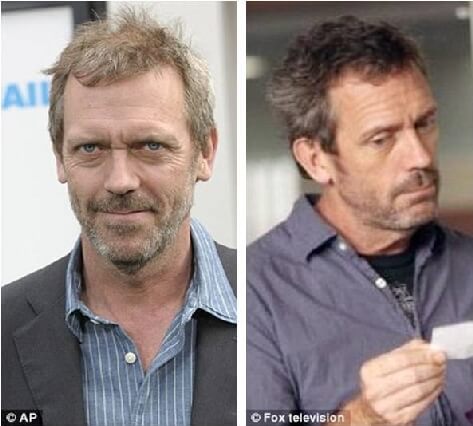
Hugh Laurie, best known for his role as Dr. House in the eponymous series, drew public attention because on the show he appeared with visibly fuller and thicker hair—something that did not match his personal and public appearances, where his hair thinning was much more evident.
The question that arises, therefore, is whether Hugh Laurie turned to a doctor for a hair transplant or opted for a less invasive solution.
Dr. K. Anastassakis explains the case of the beloved TV “doctor”:
“Mr. Laurie has openly spoken about his hair loss problem for the past 20 years. There are thousands of photos of him, but as you can see, his hair appears fuller and of a different shade when he plays ‘Dr. House,’ while it looks noticeably thinner and lighter in color in photos from premieres or live events.”
As Dr. Anastassakis mentioned in an article on Gossip TV, this visible improvement and thickening of Hugh Laurie’s hair is nothing more than the use of Kmax keratin microfibers. These keratin microfibers provide a temporary coverage of thinning areas, as they adhere to the existing hairs on the scalp.
Kevin Costner: Did He Really Have a Hair Transplant?
At his second wedding, the famous Hollywood star appeared with noticeably thicker and fuller hair. This raised the question among journalists and the public: did the actor undergo a follicular unit hair transplant to achieve his richer look, or did he rely on some other type of temporary trick?
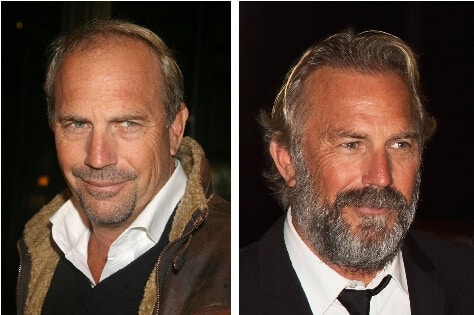
According to Dr. Anastassakis, this improvement is the result of a successful hair transplant. He specifically notes that the lighter shade of Costner’s hair greatly contributed to making the outcome appear natural.
The star’s hair transplant surgeon redesigned his frontal hairline and placed single follicular units in a random sequence, resulting in a natural and flawless outcome. The hair was not made excessively dense, and the fact that it does not grow straight in only one direction further enhances the perfection of the result.
Kevin Costner’s hairline is exactly what one would expect of a 50-year-old man—without the excessive, unnatural density that looks fake. In contrast to the follicular unit transplants of many Greek celebrities, who often opt for an unnaturally thick and pointed hairline, Kevin Costner’s case demonstrates an excellent, natural result that can be achieved through proper and effective follicular unit transplantation.
Hair Transplants and Celebrities: What Is the Cost?
Typically, restoring the hairline and increasing density in the temples requires around 2,000 follicular units. Given the light skin and hair color of the famous star, such a procedure—performed in a specialized, certified clinic by a qualified surgeon—costs between €10,000 and €15,000.
What Do Men Really Want: Thicker Hair or a Natural Look?
Thicker hair can often appear unnatural—as we all notice with wigs, which is why most men avoid them. On the other hand, when thinning is left untreated, the result may look natural but not ideal either.
The real goal, therefore, is to achieve a density that reverses thinning but in moderation—so that the outcome remains natural and does not draw attention for the wrong reasons.
A poor example of an unnatural hair transplant is that of Donald Trump. The result does not match his age, clearly revealing that he has undergone an artificial-looking procedure.
In modern hair transplantation, however, the outcome is natural because density can be increased while precisely replicating the direction, angle, and distribution of the hair. Advanced instruments and highly trained staff ensure that no one can tell any intervention took place.
Scars are a thing of the past with today’s FUE hair transplantation, and men seeking this technique can achieve thicker hair along with a natural aesthetic result.
 0
0